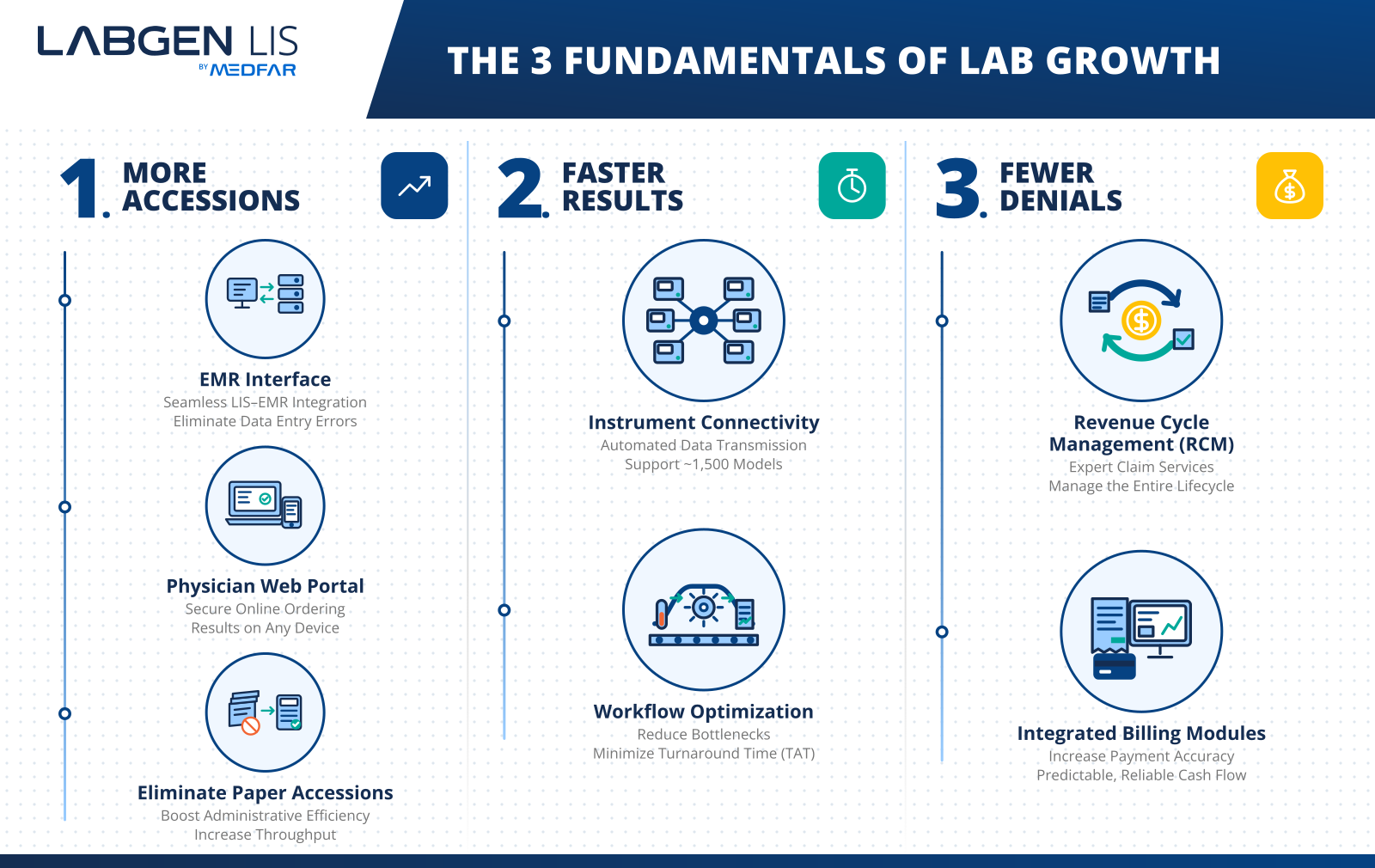
Lab growth rests on three fundamentals: more accessions, faster results and fewer denials. Each depends on the same operating backbone: the laboratory information system (LIS). When a lab plateaus, the problem is often not the science or the people. It is friction in the way orders are captured, results move and claims are prepared.
Order intake, result processing and billing data must work together as volume rises. For an explanation of the technology behind that workflow, see MEDFAR’s What Is a Laboratory Information System (LIS)? This article focuses on how the LIS affects three specific growth outcomes and where to look when progress stalls.
More accessions. Faster results. Fewer denials. Three fundamentals, one system.
What lab growth actually depends on
Growing a laboratory is not simply about doing more of the same. It means increasing volume without multiplying manual work, protecting turnaround time as demand rises and converting completed tests into reliable revenue. Drawing on more than three decades of LIS experience, MEDFAR frames sustainable lab growth around three non-negotiables:
- More accessions. Volume drives revenue only when orders arrive without avoidable re-entry or delay.
- Faster results. Turnaround time shapes the provider experience and can influence where future testing is referred.
- Fewer denials. A completed test that is not paid creates cost, rework and uncertainty instead of growth.
If one of these fundamentals weakens, expansion becomes harder to sustain.
Fundamental 1: More accessions, captured efficiently
Accessions are the lifeblood of a lab, but the goal is not volume at any cost. The goal is to capture every appropriate order with as little friction as possible. Orders typically reach a lab through three channels, and each affects efficiency differently.
| Channel | How the order arrives | Impact on growth |
|---|---|---|
| EMR/EHR interface | The provider system sends the order to the LIS; results return through the same connection. | Best path for scale: less re-entry, fewer handoffs and faster processing. |
| Provider portal | The practice creates accessions and reviews results online from a secure portal. | Extends ordering access and gives the practice a direct, consistent workflow. |
| Paper requisition | A form is faxed or delivered, then transcribed by laboratory staff. | Adds administrative effort and creates more opportunities for delay or transcription error. |
Manual transcription is a documented risk. In a study of 6,930 manually entered outpatient test results across 60 clinics, 3.7% differed from the interfaced value and 0.5% differed by more than 20% (Mays & Mathias, 2019). A broader review found that most laboratory errors occur outside the analytical phase, particularly before and after testing (Bonini et al., 2002).
Replacing avoidable transcription with interfaces and portal-based ordering is one of the clearest ways to increase throughput without adding the same amount of administrative work.
Capture every order. Re-key as little as possible.
Fundamental 2: Faster results that strengthen provider confidence
Providers and patients expect timely results. In a College of American Pathologists survey of 2,425 physicians across 81 institutions, turnaround time for routine and STAT testing ranked among the attributes physicians valued most, and among the areas with the lowest satisfaction. The study also found that 11.4% of physicians rated the ease of electronic order entry as below average or poor (McCall et al., 2016).
A scalable LIS supports faster, more consistent turnaround through two capabilities:
- Instrument connectivity. Direct analyzer connections reduce manual movement of results and help staff focus on exceptions. LABGEN states that it can connect with 99% of instruments on the market.
- Workflow orchestration. Configurable rules, queues and result delivery help orders move from accession to verification without unnecessary waiting or duplicate steps.
For Alex Alvarez, founder and CEO of Helix Diagnostics, turnaround time and responsiveness are part of the service a lab delivers to providers:
“If you answer the phone and turn results around in 24 hours, you’ve already beaten half the industry.”
Alex Alvarez, founder and CEO, Helix Diagnostics, in The Lab Entrepreneur
Fundamental 3: Fewer denials and more predictable cash flow
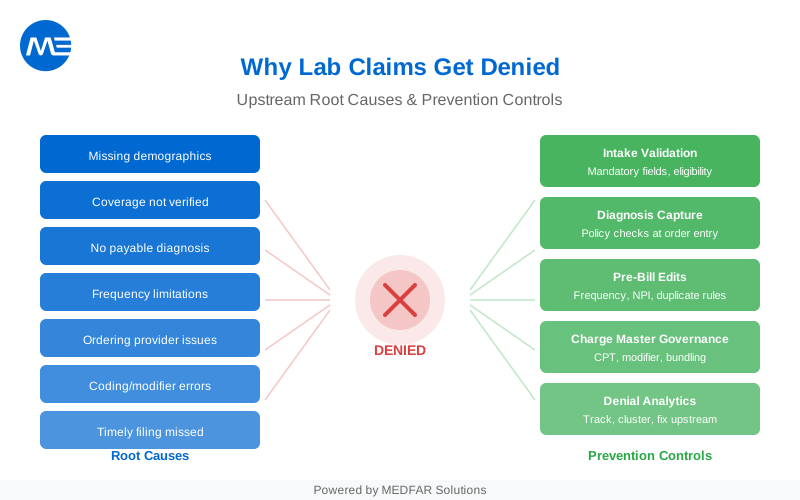
Laboratories cannot reinvest in people, instruments or growth if completed testing does not translate into payment. Denials often begin upstream, with incomplete demographics, missing coverage data, authorization gaps or coding errors, then surface only after the test is complete.
- A wider provider trend. In Experian Health’s September 2025 State of Claims survey, 41% of providers reported denial rates of 10% or more and 54% said claim errors were increasing.
- Data quality is a leading cause. Half of surveyed providers cited missing or inaccurate data as a top cause of denials, ahead of authorization and patient-registration errors (Experian Health, 2025).
These survey findings describe healthcare providers broadly, not a laboratory-specific denial benchmark.
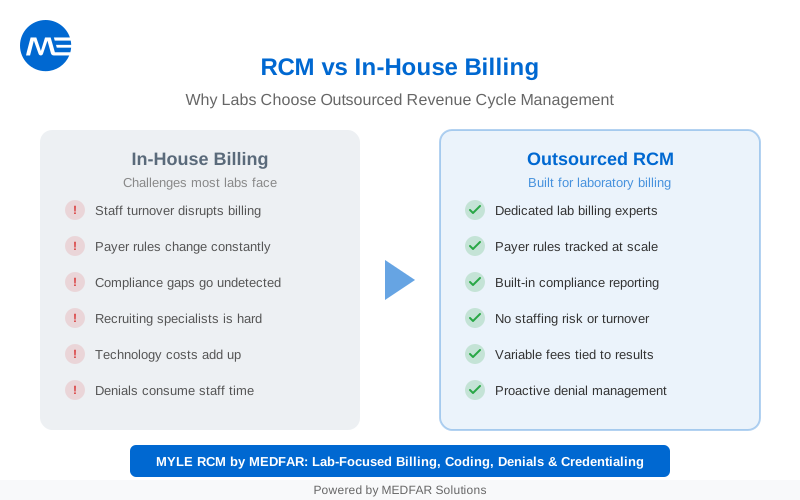
A high-performing LIS should help prevent avoidable denials by validating information early, preserving claim-support data and routing rejections into a visible work queue. Integrated billing capabilities or a dedicated revenue cycle management service can then support consistent follow-up.
Every avoidable denial prevented preserves time, cash flow and capacity for growth.
One accession across a lab day
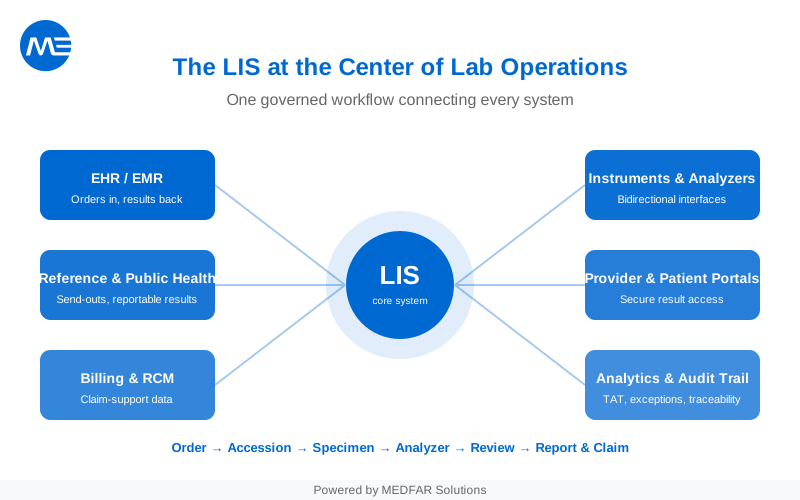
The three fundamentals become easier to see when one specimen is followed from order to payment:
- 1 · Order. The provider orders through the EMR/EHR or portal; the LIS creates the accession without duplicate entry.
- 2 · Collection and receipt. The specimen is labeled and tracked; missing demographics or coverage details are flagged early.
- 3 · Analysis. Interfaced instruments send results to the LIS; staff review exceptions instead of transcribing every value.
- 4 · Verification and release. Rules and review queues help normal and abnormal results follow the appropriate path.
- 5 · Delivery. Verified results return to the provider system or portal, with critical-value workflows where needed.
- 6 · Billing. The accession supports claim creation and makes rejections visible for follow-up instead of silent write-off.
Six steps. One governed record.
The LIS capabilities that shape growth
| Capability | What it supports | Growth fundamental |
|---|---|---|
| EMR/EHR interfaces | Bidirectional orders and results with provider systems | More accessions |
| Provider portal | Online ordering, requisitions and result access | More accessions |
| Instrument connectivity | Automated result transfer across supported analyzers | Faster results |
| Workflow rules | Queues, exceptions and configurable verification steps | Faster results |
| Results delivery | Timely posting to connected systems and portals | Faster results |
| Integrated billing | Claim-support data and rejection visibility | Fewer denials |
| RCM services | Specialized claim follow-up across the revenue cycle | Fewer denials |
| Analytics | Views of turnaround, volume, workload and denial trends | All three |
When one capability drags, all three fundamentals can feel the effect.
Signs your lab has outgrown its LIS
A lab may be ready to adopt or replace an LIS when several of these patterns persist:
- Paper requisitions remain part of routine intake.
- Staff re-enter the same information in the LIS, billing system or portal.
- Adding an analyzer or a provider connection requires a long custom project.
- Providers call the lab for status because they cannot see results or progress.
- Billing rejections are discovered late or remain outside a managed queue.
- Volume is rising while turnaround time, overtime or backlog is worsening.
- The vendor’s update cadence and product roadmap no longer match the lab’s needs.
Recognize more than two? It is time to quantify the operational cost of staying put.
What an aging LIS really costs
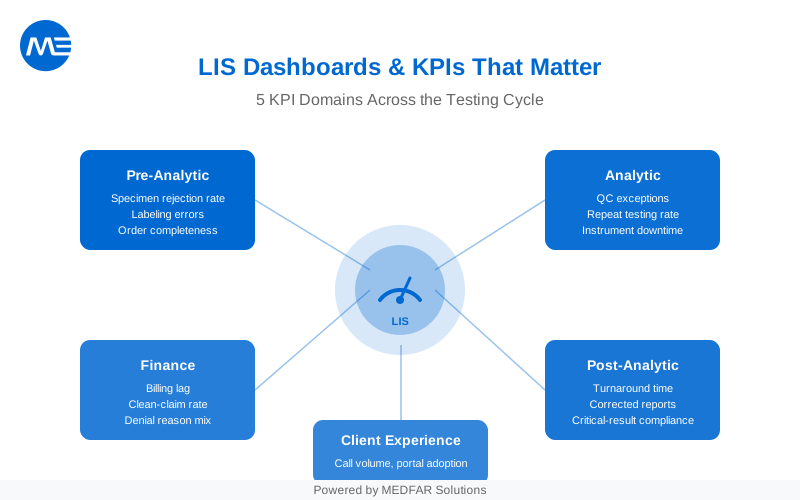
The most expensive LIS is not automatically the one with the highest license fee. It may be the system that keeps administrative work, delays and leakage in the laboratory month after month. Evaluate the current system against three numbers: hours of manual entry per week, turnaround time by test category and denial rate by payer.
Then compare the cost of improvement with the full cost of change. For a detailed framework, see Laboratory Information System Costs: Understanding Pricing and ROI.
That measurement should be part of a daily operating rhythm. As Adam El Hosseiny, COO of Access Medical Lab, explains:
“Total completed, total pending, downtime, uptime. Those are your key KPIs.”
Adam El Hosseiny, COO, Access Medical Lab, in The Lab Entrepreneur
Choosing an LIS built for growth
Seven questions cover much of the evaluation. They complement MEDFAR’s decision-maker’s guide to choosing an LIS:
- Which of our current provider systems can you connect today, and what does a new interface require?
- Is the provider portal integrated with the LIS or managed as a separate product and workflow?
- Which of our analyzers are already supported in production?
- How are verification rules, flags, exceptions and critical values configured?
- How does the platform support clean-claim preparation and rejection tracking?
- What is the migration methodology, including data mapping and validation?
- What do implementation, training, support and product updates look like after go-live?
Technology matters, but so does the relationship behind it. Adam El Hosseiny describes how Access Medical Lab approaches technology partnerships:
“Any partner of ours is an extension of our business.”
Adam El Hosseiny, COO, Access Medical Lab, in The Lab Entrepreneur
Is your infrastructure ready for the next level?
If growth has stalled, look at the three fundamentals. Are orders still being re-keyed? Are instrument or review bottlenecks delaying results? Are preventable denials consuming staff time and cash flow? A modern LIS should reduce friction across the full order-to-payment workflow, not simply store laboratory data.
See LABGEN on your own workflows
Explore how orders, instruments, results and billing can work together.
FAQ
What are the three fundamentals of lab growth?
More accessions, faster results and fewer denials. Accessions create revenue opportunity; turnaround time shapes the provider experience; and denial prevention helps completed tests become collected revenue. All three depend on the LIS and its connected workflows, which is why infrastructure deserves attention when a lab reaches a growth plateau.
Why are paper requisitions a problem for a growing lab?
Paper requires manual handling and usually creates a transcription step. Manual transcription is slower to scale and introduces a documented risk of discrepancy. Interfaces and secure provider portals can reduce re-entry, make required information visible earlier and allow administrative capacity to grow more slowly than test volume.
How common are laboratory claim denials?
Denial rates vary by payer, specialty and front-end controls. In Experian Health’s 2025 State of Claims survey, 41% of surveyed healthcare providers reported denial rates of 10% or more. This is a broader healthcare finding, not a laboratory-specific benchmark; labs should measure their own denial rate by payer and denial reason.
How can an LIS improve turnaround time?
An LIS can remove manual steps between order and result. Instrument interfaces reduce transcription, rules route exceptions to the right reviewer, and verified results can return directly to connected provider systems or portals. The benefit depends on configuration, staffing and workflow design, not the software alone.
Go further
- The Ultimate Guide to Scaling Your Lab
- How to Choose the Right Laboratory Information System: A Decision Maker’s Guide
- Laboratory Information System Costs: Understanding Pricing and ROI
External sources
- Mays JA, Mathias PC. Measuring the rate of manual transcription error in outpatient point-of-care testing. JAMIA, 2019;26(3):269–272. Reports discrepancies between manually entered and interfaced outpatient test results.
- Bonini P, et al. Errors in Laboratory Medicine. Clinical Chemistry, 2002;48(5):691–698. Reviews where errors occur across the laboratory testing process.
- McCall SJ, et al. Physician Satisfaction With Clinical Laboratory Services: A CAP Q-Probes Study of 81 Institutions. Archives of Pathology & Laboratory Medicine, 2016;140(10):1098–1103. Examines physician priorities and satisfaction with clinical laboratory services.
- Experian Health. 3rd Annual State of Claims Survey. September 2025. Reports provider-reported denial rates and leading causes of claim errors.
About LABGEN LIS
LABGEN LIS, developed by MEDFAR, is designed to connect the workflows a growing clinical laboratory depends on: provider orders, instrument results, review, delivery and billing support. MEDFAR highlights broad instrument compatibility, unlimited EMR/EHR integrations, portals, dedicated support and integrated MYLE RCM options. Explore LABGEN LIS or book a demo.