Migration is a clinical change, not an IT chore.
Every result has context. Every field has meaning. When you move data to a new LIS, you must prove that meaning survived the trip.
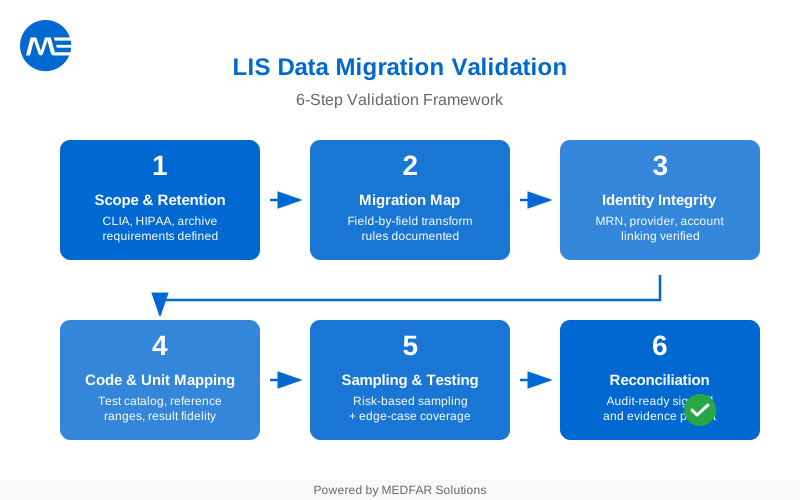
Validation Starts with Scope and Retention Needs
Start by defining what “migration” means for your lab. Some teams move everything; others migrate current operational data and keep older history in an accessible archive.
Your scope should explicitly consider record retention and retrievability requirements under CLIA, including retention expectations for items like test reports and requisitions (see 42 CFR 493.1105).
Then layer in privacy and security controls for electronic protected health information (ePHI). HIPAA’s Security Rule includes requirements for audit controls and integrity safeguards (see 45 CFR 164.312 and the HHS Security Rule overview).
Deliverables to lock in before anyone moves data:
- Migration scope statement (what moves, what archives, what remains accessible).
- Data inventory (systems, tables/files, document stores, interfaces).
- Retention and access plan (who needs what, how fast, and from where).
- Validation plan with acceptance criteria and sign-off roles.
A Migration Map Prevents Silent Data Drift
A migration map is your single source of truth. It states exactly how each field transforms from the legacy system to the destination system, including default values and any calculated logic.
Treat the map like a controlled document. Version it, review it, and approve changes. That approach aligns with general validation principles used for regulated software, where requirements and traceability matter (see FDA’s General Principles of Software Validation).
Validation focus by data domain:
| Data Domain | Examples | Validation Focus | Common Failure Modes |
|---|---|---|---|
| Patient & client master | MRN, name, DOB, provider, account | Uniqueness, merges, formatting, referential links | Duplicate patients, broken links, truncated names |
| Test catalog | Test codes, panels, orderables, methods | Code-to-result mapping, unit consistency, panel logic | Wrong analyte, wrong unit, panel children missing |
| Results history | Numeric, qualitative, comments, attachments | Value fidelity, flags, corrected history, timestamps | Value shift from transforms, missing comments |
| Reference ranges | Age/sex, method, site-specific | Rule logic, effective dates, units | Ranges applied to wrong population |
| Workflow artifacts | Specimen status, cancel reasons, audit trail | State transitions, timestamps, user attribution | Lost status history, missing amendments |
| Interfaces & routing | EMR routes, printer rules, outbound formats | Message integrity, routing rules, acknowledgements | Results sent to wrong endpoint |
If you only do one thing, do this: write acceptance criteria per domain. “Looks right” is not a criterion.
Patient Identity Integrity Is Non-Negotiable
Validate identity before you validate results. If MRNs, client accounts, or provider IDs are mis-linked, your validation sampling can pass while real users fail.
Include both happy-path and messy-path scenarios. Real data contains merges, aliases, and typo fixes.
- Confirm uniqueness rules (MRN, enterprise ID, or lab-assigned IDs).
- Test merged records: confirm merged history is complete and ordered.
- Test duplicates: verify dedup rules do not collapse distinct patients.
- Verify provider and client account mappings, including inactive accounts.
- Validate address and phone formatting so downstream systems don’t reject messages.
Add a reconciliation step: compare patient counts, merge counts, and orphaned records between source and target. Investigate every delta, even if it looks small.
Test Code and Unit Mapping Needs Controlled Rules
Legacy test catalogs evolve over time. Panels change. Methods shift. Migration is the moment these inconsistencies surface.
Build a mapping row for every orderable and every resultable. If you use standard codes like LOINC, document them too, but validate the operational code-to-result relationship first.
Mapping sheet fields:
| Field | What to Capture | Why It Matters |
|---|---|---|
| Legacy order code | Exact source identifier | Drives correct order intake and history matching |
| Legacy result code | Child analyte identifier (for panels) | Prevents swapped or missing analytes |
| New order code | Destination orderable | Controls ordering, routing, and billing logic |
| New result code | Destination resultable | Controls display, rules, and interfaces |
| Units | Source and destination units | Prevents silent numeric misinterpretation |
| Method/instrument | If method-specific | Reference ranges and interpretive comments depend on method |
| Reference range rule | Age/sex/site logic + effective dates | Protects clinical meaning |
| Transform logic | Rounding, conversions, value mapping | Must be tested and approved |
| Owner + approval date | Named reviewer | Creates accountability |
If a unit conversion is required, validate it with test vectors and peer review. One wrong conversion can poison years of history.
Result Meaning Depends on Reference Ranges and Flags
A migrated result is more than a value. It includes the units, reference interval, abnormal flags, specimen context, and any amendments or comments.
Validate “meaning” with targeted checks:
- Reference range logic matches age, sex, site, and method rules.
- Abnormal and critical flags match the legacy system for the same inputs.
- Qualitative mappings (e.g., POS/NEG, DETECTED/NOT DETECTED) are consistent.
- Corrected and amended results preserve the full history, including timestamps and reasons.
- Attached documents and images remain accessible and correctly linked.
LIS migrations often require workflow-specific validation beyond simple field checks, especially for rich report structures and amended results (see Benitez et al., 2025).
Sampling Plus Edge-Case Testing Catches What Bulk Tests Miss
Sampling is necessary for volume. Edge-case testing is necessary for safety. Combine both.
Use risk-based thinking: prioritize high-volume assays, high-impact assays, and workflows that trigger rules, billing, or routing. General validation guidance emphasizes planning tests to address risk and intended use (see FDA’s General Principles of Software Validation).
Common edge cases to include:
- Reflex and algorithm-driven testing (where one result creates the next order).
- Canceled, recollected, and partially resulted panels.
- Delta checks and autoverification rules that depend on prior history.
- Special populations (pediatrics, pregnancy-specific ranges, geriatric ranges).
- Client-specific report formats and comment libraries.
- Split billing scenarios (client billing rules and special billing holds).
Document why each case is in scope. That note becomes part of your evidence file.
Reconciliation and Sign-Off Create an Audit-Ready Record
Validation ends with reconciliation. You should be able to answer: How many records moved, how many failed, what changed, and who accepted the risk?
Close with controls that support integrity and accountability, including audit trails and access monitoring consistent with HIPAA’s technical safeguard expectations (see 45 CFR 164.312).
A sign-off packet should include:
- Final reconciliation report (counts by domain, plus exception list and dispositions).
- Validation evidence (test scripts, query outputs, reviewer initials).
- Approved mapping documents and change log.
- User acceptance testing summary with issues and resolutions.
- Rollback or downtime plan for go-live.
- Named approvals from lab leadership, operations, and IT/security.
Need a structured transition plan? MEDFAR summarizes its migration approach and support model here: Switching Your LIS with LABGEN.
FAQ
How far back should we migrate results?
Start with what clinicians and billing teams need day-to-day, then confirm retention and retrieval obligations under CLIA (see 42 CFR 493.1105). Many labs migrate a practical window and keep older history in an accessible archive.
Do we need to migrate every comment and attachment?
If comments or attachments inform clinical meaning or compliance, keep them retrievable and correctly linked. Validate link integrity with a targeted sample that includes legacy formats.
What’s the minimum validation evidence we should keep?
Keep the approved mapping, test scripts, results, exception handling notes, and sign-offs. Align evidence to integrity and audit control expectations described in HIPAA technical safeguards (see 45 CFR 164.312).
How do we handle downtime during cutover?
Write a downtime workflow and a rollback plan before go-live. Assign roles, define manual capture, and test recovery with realistic scenarios.
If you’re evaluating a new LIS for a migration or a start-up, see how LABGEN is positioned for deployment support and setup: LABGEN | Laboratory Information System (LIS).