How the institution’s largest digital transformation project digitized the patient journey in more than 100 clinics and teams, and is now opening the door to artificial intelligence
saved per physician or professional each week after switching to MYLE.
fewer missed appointments in primary care since MYLE was deployed.
in recurring savings per year .
additional hours recovered per clinician each week in the AI Scribe pilot projects.
See how MYLE could give your physicians and staff time back every day.
About Établissement Centre-Sud-de-l’Île-de-Montréal-Universitaire
Établissement Centre-Sud-de-l’Île-de-Montréal-Universitaire is one of the largest health institutions in Québec. With nearly 800 physicians, split almost evenly between family physicians and specialists, it serves about 325,000 Montrealers, from its hospitals and outpatient clinics to its local community service centres (CLSCs) and its youth and addiction services. It also holds regional and supra-regional mandates, and manages many IT systems shared by health institutions across the island of Montréal.
Its digital transformation is built around major cross-functional programs, including Digital Clinics, its largest digital transformation project to date:
- 105 clinics or CLSC teams use the integrated MYLE EMR
- 2,000 professionals use these new technologies
- More than 700,000 appointments are managed each year
- 51,300 patients are registered on the MYLE Patient Portal
The Challenge
It all started during the pandemic. During a mass vaccination operation at the Montréal Convention Centre, the institution successfully combined several innovative technologies. Back in the clinics, one thing was clear: going back to paper was no longer an option. That’s how the idea of digital clinics was born.
Day to day, outpatient teams wrote their notes, forms, prescriptions and requisitions by hand. Appointments were managed in paper calendars or across several systems, and confirmed by phone. Results came in by fax, staff had to search several systems for records and walk across the building to retrieve information, then send documents out for scanning. Patients lined up at reception to check in, and clinical-administrative requests were tracked on paper or verbally.
Defining Priorities
Born of a collaboration between clinicians, physicians and IT specialists, the Digital Clinics program was built on clear guiding principles:
- Reduce paper use
- Simplify the technology ecosystem, with a single patient index and fewer systems to manage
- Improve the patient experience through technology, while keeping processes human
- Digitize and automate administrative processes
“We had an ambition: to transform our clinical practices to deliver more efficient, more modern services, and to reduce the administrative burden.”
— Établissement Centre-Sud-de-l’Île-de-Montréal-Universitaire, Colloque informatique santé 2025 (translated from French)
The selection criteria were clear: features broad enough to cover its needs, a competitive price and a reliable vendor, ideally one that already understood how Québec’s health network works. MYLE also had a major advantage: many physicians, who work both in the institution and in private clinics, were already using it.
“The MEDFAR team is very committed: they meet their deadlines, they work collaboratively, and they’re really easy to work with. They always deliver. I would highly recommend them.”
— A member of the management team, Établissement Centre-Sud-de-l’Île-de-Montréal-Universitaire (translated from French)
The Solution: All the Information in One Place
At the heart of the digital clinics, the integrated MYLE EMR brings clinical information together and supports patients throughout their journey. It connects to the patient index, to lab, imaging and pathology results, to the Québec Health Record (QHR) and to the institution’s clinical information system. Each component addresses one of the institution’s priorities:
- Appointments and reminders: appointments are displayed electronically in one integrated view, and confirmed automatically by text message.
- Centralized record: results flow automatically into the MYLE EMR, the QHR can be accessed in context, and dynamic forms are pre-filled automatically from the patient’s record.
- Team communications: clinical-administrative tasks and their follow-up are recorded directly in the EMR, with a full audit trail.
- Electronic transmission: prescriptions are sent to community pharmacies, and patients access their information through the Patient Portal.
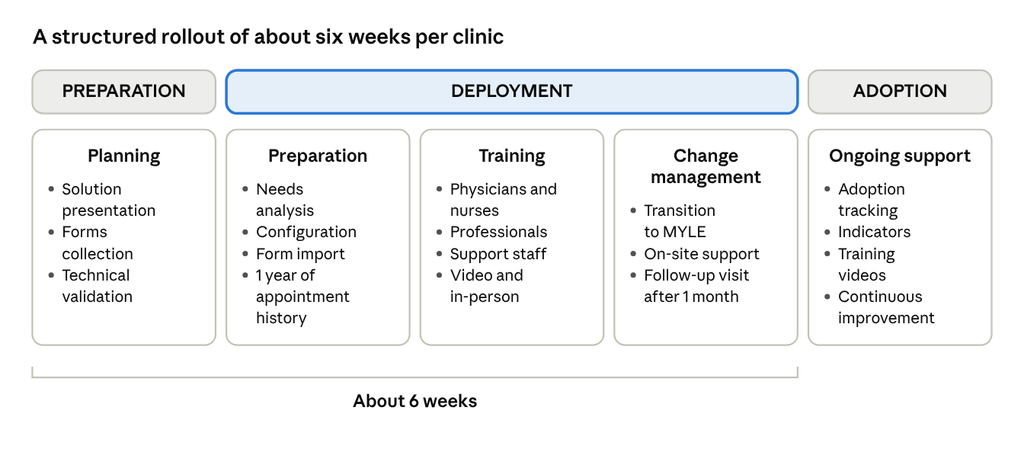
The Rollout: A Proven Recipe for More Than 100 Clinics
The rollout happened in stages. In 2023, the institution began consolidating its systems, including appointments, pharmacies and labs, and launched its first digital clinics in hospital settings. Once that consolidation was completed in 2024, the rollout expanded in 2025 to CLSCs and to youth and addiction services.
For each clinic, a structured deployment method was put in place:
“Of course, not everything was simple. Convincing and rallying all partner departments took a lot of change management effort.”
— Établissement Centre-Sud-de-l’Île-de-Montréal-Universitaire, Colloque informatique santé 2025 (translated from French)
The Results
Up to 5 hours a week back for every clinician
Physicians and professionals save up to 1 hour a day, or up to 5 hours a week. Digital, structured notes are available in real time and can be searched by keyword. Every medico-legal action is recorded and traceable, and team communication is easier: more than 430,000 tasks were created in MYLE over the past 12 months.
“For physicians, the added value is in communication, especially since the notes I handed off used to get mixed up. There’s an adjustment period, but the system is easy to use!”
— A physician at Établissement Centre-Sud-de-l’Île-de-Montréal-Universitaire, Colloque informatique santé 2025 (Translated from French)
43% fewer missed appointments in primary care
Since MYLE was deployed, missed appointments have dropped by 43% in primary care, thanks in large part to automated text reminders that replaced phone confirmations.
It was a long-awaited result: in primary care, missed appointments were a significant issue, and text reminders were among the features the team was counting on most.
More than $300,000 in recurring savings per year
Streamlined processes, along with less printing, transport and outsourced scanning, save the institution more than $300,000 a year. With nearly 240,000 digital notes written every quarter, the institution estimates that close to 2.5 million sheets of paper no longer need to be printed each year.
What’s Next?
The results above were achieved without artificial intelligence. The next step is to unlock MYLE’s full potential with its AI tools, and the first results are already in.
AI Scribe: up to 8 hours recovered per week
With MEDFAR, the institution ran two ambient AI scribe pilot projects. The conversation is captured, the AI generates a note, and the clinician reviews and validates it before it is filed in the record.
- MASMA (adult mental health access mechanism): 11 clinicians over 13 weeks. An assessment takes up to 40% less time, dropping from 3 hours to 1 hour 50 minutes, which adds up to 7 hours recovered every week.
- Youth protection (DYP): 10 clinicians over 10 weeks. Time spent writing notes and reports dropped from 12 to 4 hours a week, up to 67% less, and 100% of clinicians recommend the tool.
Building on these results, the institution is launching a pilot project at the Verdun university family medicine group (U-FMG) to gradually roll out the scribe to about 300 clinicians, with a clear goal: increase appointment availability by at least 20%.
More AI tools to come
The institution will also be able to count on the other AI capabilities already available in MYLE, as well as other tools, to become even more efficient:
- AI Indexing: files incoming faxes and reports to the right record automatically, so clinicians see results sooner and urgent ones don’t slip through.
- AI Forms: fills out forms automatically using information from the encounter, and soon from the patient’s record as well, freeing clinicians from paperwork.
- AI Call Agent: handles routine patient calls and books appointments directly into the schedule, so reception staff can focus on the work that needs a human touch.
- More accessible data: MYLE Analytics dashboards give each department more autonomy in tracking its indicators.
- Stronger communication with patients: expanded use of the Patient Portal replaces sending information by fax or phone.
- A shared way of working: the same tools in hospitals and CLSCs, for more consistency and easier comparisons across settings.
What Other Institutions Can Learn
The experience of Établissement Centre-Sud-de-l’Île-de-Montréal-Universitaire shows that a large-scale digital transformation depends as much on support as on technology:
- Choose a committed partner. Beyond selecting the right technology for your needs, look for a vendor that understands how the network works and stays present before, during and long after implementation. Constant on-the-ground support and a follow-up visit strengthen adoption and teams’ digital autonomy.
- Count on active medical leadership. The ongoing involvement of the clinical team and of every department made the project an organizational priority.
- Identify champions from the start. Super users in each clinical department make adoption and change management easier.
- Make the most of the tools you have. With the right EMR, an institution has a solid foundation to expand its use and optimize operations at scale, starting now. The institution’s AI Scribe pilot projects are a good example. Every gain in digital maturity also makes the transition to Québec’s new digital health record, the Dossier santé numérique (DSN) easier.
About Établissement Centre-Sud-de-l’Île-de-Montréal-Universitaire: A university institution within Santé Québec that provides care and services in its hospitals, outpatient clinics and CLSCs, as well as in youth and addiction services.
About MYLE: An EMR developed in Québec by MEDFAR that brings the clinical record, appointment booking, the Patient Portal, communication with patients and teams, and AI tools like the AI Scribe together in a single platform.
Ready to take your institution digital too?
Discover how MYLE supports institutions that aim to work differently. Book a meeting with a MEDFAR expert.

Looking to modernize your practice too?
Discover how MYLE supports clinics that aspire to work differently. Book a meeting with a MEDFAR expert.