Before We Talk AI, Let’s Talk Reality
Our healthcare system is stretched to its limits. Studies show that more than half of physicians display signs of burnout1. At the same time, access to care remains a critical challenge: more than 1 in 5 Canadians (≈6.5M people), do not have a family doctor2. On top of this, healthcare spending continues to rise at a pace that is increasingly difficult to control. Taken together, these problems can feel irreconcilable.
As a healthcare professional, your most valuable asset is time. Yet for many physicians, it is consumed by systems and tasks that add little to patient care, and nothing to the bottom line.
The Real Problem
1. You Spend More Time With the EMR Than With the Patient
Stanford Medicine’s 2023 EHR time study found that an average of 31 minutes are spent on behalf of each patient and that physicians spend more minutes with the EMR than with the patient1. Multiply that by 20 visits a day, every day of the year, and the true cost of an EMR that fails to give time back becomes impossible to ignore.
2. Admin Overhead Eats Your Margin
~23% of physician earnings go to admin/overhead3. On a typical gross salary of $330K, that’s roughly $75K/year that does not reach the physician:
• $25K in space rent, IT, office & and medical supplies
• $50K in personal costs to manage the admin load
Why The Problem Persists And Why MYLE Can Make A Difference
The EMR landscape in Canada is dominated by 2 types of systems. Neither equipped to deliver the innovation physicians need today.
1. Legacy EMRs: Stuck in the Past
Most EMRs are difficult to use, evolve slowly or not all, and were born during the first wave of provincial and federal funding more than 15 years ago. They were designed in a rush to replicate paper-based workflows and to meet grant requirements, not to transform care delivery.
Over time, many were acquired by large corporations whose core business is not EMRs, Telus (telecommunications), Loblaws (retail and pharmacy), Well Health (clinic operator). Innovation has slowed to a crawl. Built on outdated technology, these platforms cannot evolve without a full rebuild, a prohibitively expensive and unlikely step for their owners.
2. Emerging EMRs: Promising But Thin on Depth and Breadth
On the other end of the spectrum, new entrants offer sleek features and “bells and whistles” for some workflows. But they lack the depth, stability, and security required for real case scenarios. With small teams and limited resources, they struggle to keep pace with regulatory requirements, enterprise-grade security, and the rapid cycle of innovation. As a result, they remain vulnerable and often short-lived.
More Time Spent In The EMR Than With Patients
31 mins spent on behalf of each patient :
- 12 mins interacting with the patient during the visit
- 8 mins interacting with the EHR during the visit
- 11 mins interacting with the EHR outside the visit
How Your Typical Day Really Breaks Down
6 hours on patient visits
- 4 hours with patients: interviewing, examining, and providing care
- 2 hours with the EHR: searching records, scrolling, charting, clicking through fields
3.6 hours on tasks outside consultations
- Managing inboxes, chasing lab results, coordinating follow-up
- Completing forms, and other administrative tasks.
And these hours don’t just happen in the clinic. They spill into the margins of the day, squeezed in between patients, over lunch, after a long day at the office, or at home (on the couch in your pajamas).
👉 You may also find this article interesting: How 350+ B.C. physicians are shaping the next generation of AI-powered EMRs.
Why MYLE Is Leading A True Change
MYLE occupies a unique position that neither legacy nor emerging EMRs can claim.
- Modern, mature all-in-one web platform: Built on the latest web technologies, MYLE combines the stability of a mature platform with the flexibility to innovate at scale.
- Physician-led design: From the start, MYLE was shaped in close collaboration with clients through a medical advisory board of physicians and healthcare professionals, ensuring the product reflects real-world clinical needs.
- The power of one focus, one-platform: With more than $12M invested in R&D focused on a single Canadian platform, MYLE continues to evolve in lockstep with the realities of Canadian healthcare.
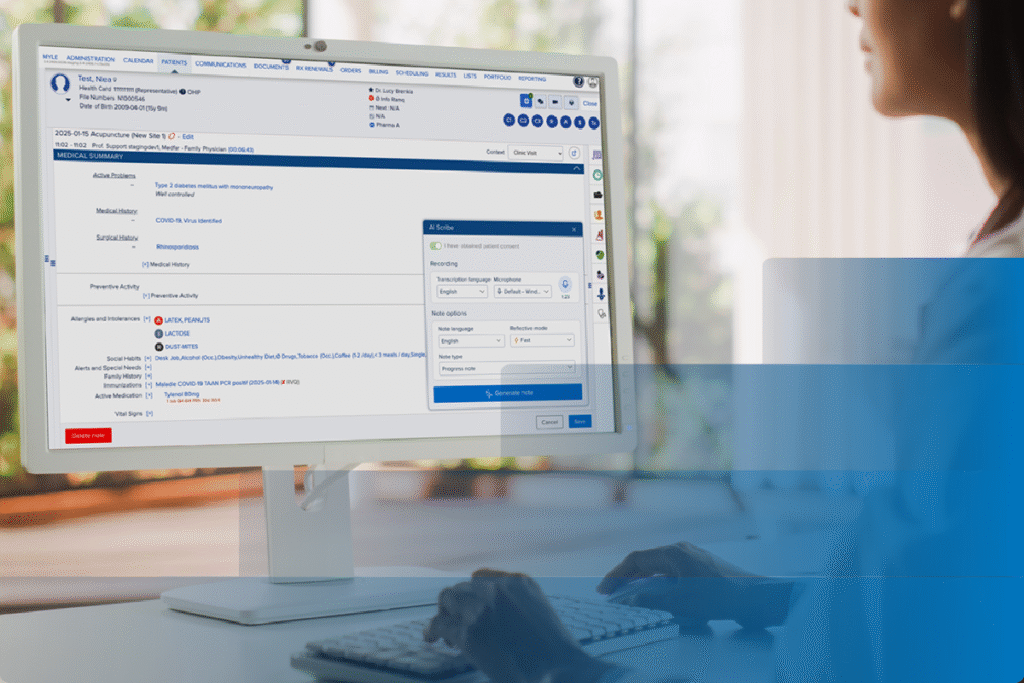
This laser-sharp focus on one mission, building the best EMR for physicians, directly addresses the problems most clinics still face today. By reducing the time physicians spend interacting with the EHR and by shifting repetitive administrative tasks from humans to AI-driven automation, MYLE restores time to where it matters most: patient care.
“We started MEDFAR to drive Excellence and Efficiency in healthcare. AI offers a unique opportunity to solve the two problems above. What AI makes possible today is, in many ways, a dream come true. Now, it’s about making the right investments, listening relentlessly to our users, and staying bold enough to innovate where others don’t dare. Very soon, it will no longer be optional : clinics will either leverage AI to turbocharge efficiency, or risk breaking under the weight of inefficiency.”
— Elias Farah, CEO, MEDFAR Clinical Solutions
| Legacy EMRs | Emerging EMRs | MYLE | |
| Technology Base | Built over a decade ago on outdated tech | Modern but lightweight | Modern, mature web-based platform |
| Origins | Designed quickly to replicate paper workflows and meet funding requirements | New entrants chasing workflow optimization with flashy features | Purpose-built with physician advisory board, rooted in clinical realities |
| Ownership / Focus | Owned by large corporations with little focus on EMR innovation | Small teams with limited resources and security gaps | 100% focused on EMR innovation |
| Capacity to Innovate | Minimal, full rebuild required to evolve | Limited, lack enterprise-grade depth and scale | Continuous, Canadian-led R&D with $12M+ invested yearly |
| Sustainability | Stagnant, difficult to modernize | Vulnerable, often short-lived | Stable, growing, and pulling further ahead of competitors |
Get the Full Report
Sources
1. How Doctors Feel About Electronic Health Records. Stanford Medicine EHR Poll Presentation, 2023. https://med.stanford.edu/content/dam/sm/ehr/documents/EHR-Poll-Presentation.pdf
2. Canadian Medical Association (CMA), 2022. “Submission to the House of Commons Standing Committee on Health.” https://www.cma.ca/our-focus/administrative-burden/facts 3- How much do family physicians make in Canada? MD Financial Management. https://invested.mdm.ca/how-much-do-family-physicians-make-in-canada
3. How much do family physicians make in Canada? MD Financial Management. https://invested.mdm.ca/how-much-do-family-physicians-make-in-canada