The Growing Gap Between Physician Burnout and Patient Access Can Feel Irreconcilable
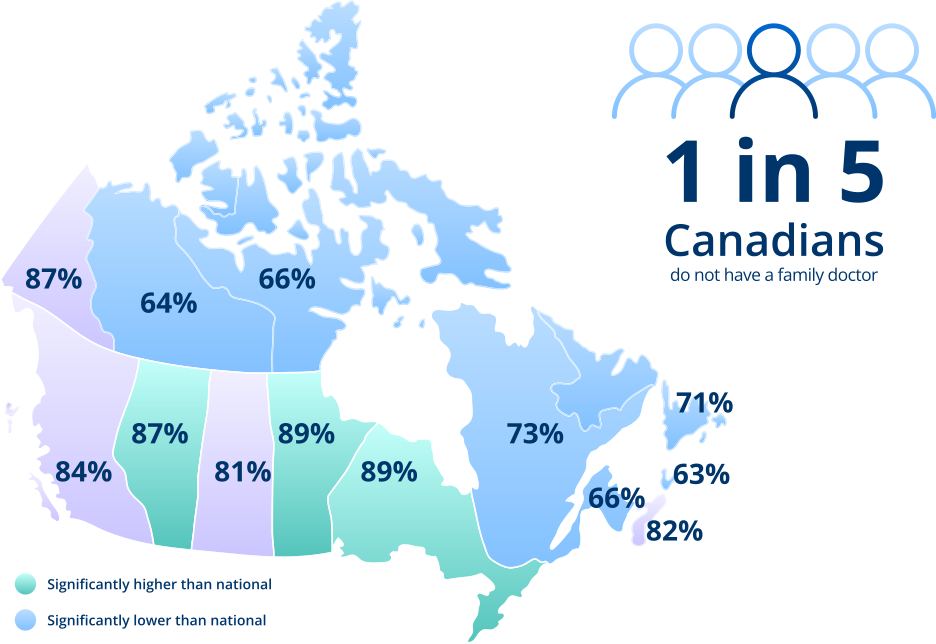
Our healthcare system is stretched to its limits. Research shows that 90% of physicians say preparing clinical records contributes to professional burnout.¹ At the same time, access to care remains a critical challenge: more than 1 in 5 Canadians (≈6.5M people), do not have a family doctor.² On top of this, healthcare spending continues to rise at a pace that is increasingly difficult to control. Taken together, these problems can feel irreconcilable.
Something has shifted. AI is rapidly becoming part of Canadian healthcare, with 68% of physicians already using AI scribe in their practice. This isn’t a distant trend, it’s already here.³ And it isn’t only in the numbers: on the Reimagine Healthcare podcast, Dr. Samuel Gareau-Lajoie unpacks why the AI revolution in medicine is already underway. For the first time, there’s a real opportunity to address these long-standing challenges and restore joy and efficiency to clinics. To see why that matters so much, we have to look at where a physician’s time actually goes.
WHERE THE TIME GOES
Physicians Spend More Time With the EMR Than With The Patient
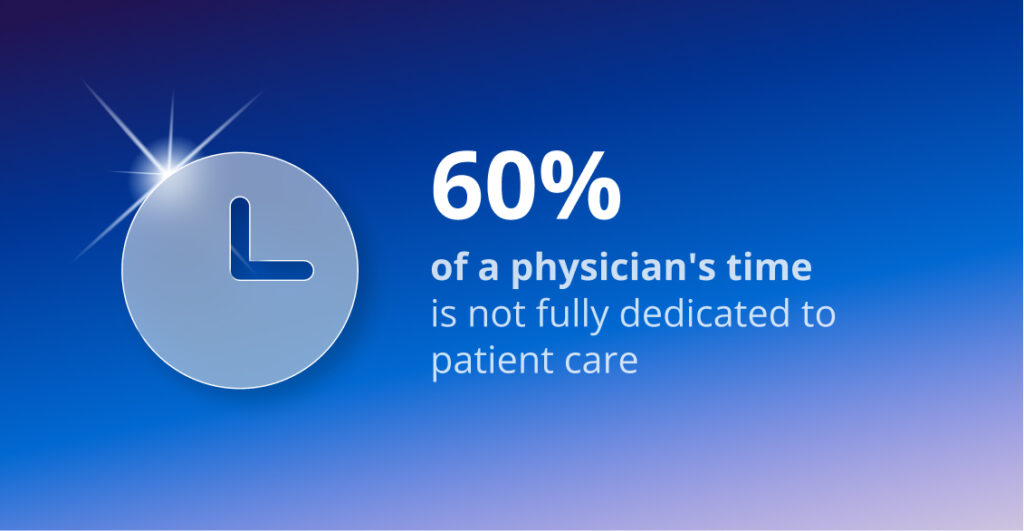
In 2018, Stanford Medicine and The Harris Poll published a national survey revealing a striking reality: primary care physicians spend more time interacting with the electronic health record than with their patients. On average, of the 31 minutes devoted to each patient, 19 minutes, or roughly 60%, are spent in the EHR, compared with 12 minutes of direct patient interaction.⁴
Across a full day, week, and year of practice, even a few minutes lost at each visit can quickly add up to hundreds of hours.
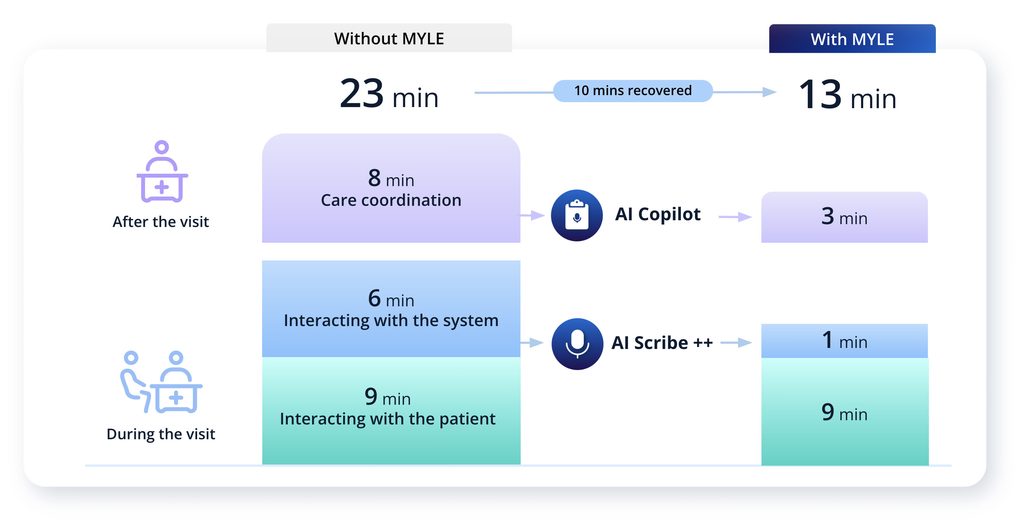
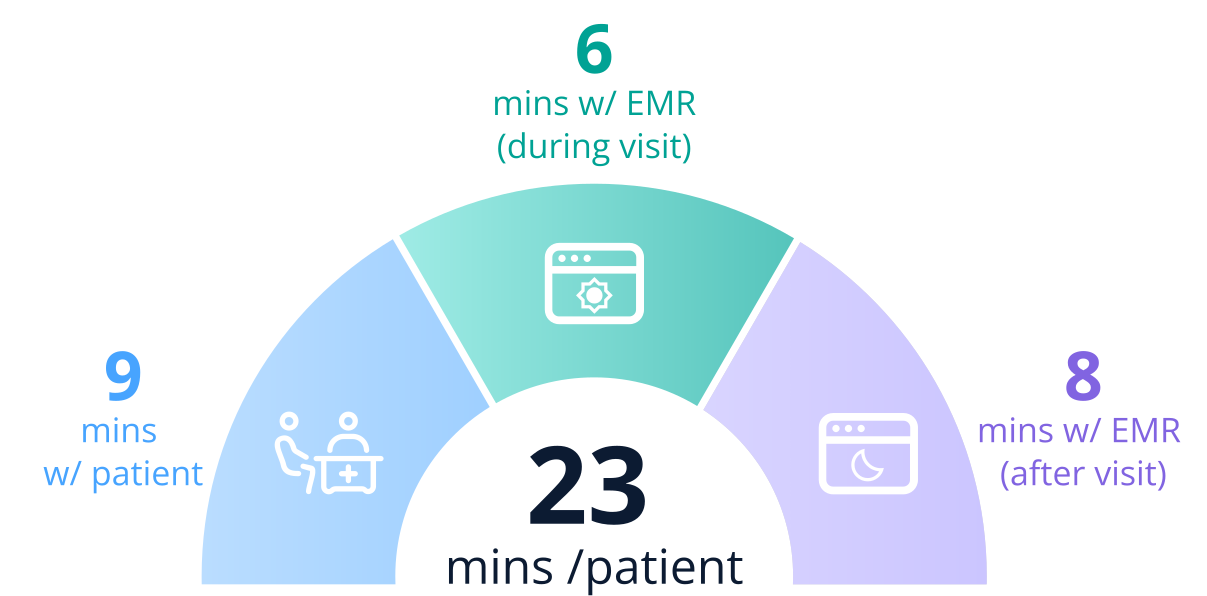
Similar research conducted by MEDFAR across Canadian clinics confirms this reality: physicians spend an average of 23 minutes per patient on clinical and administrative tasks, including 14 minutes spent directly looking at their screen, 6 minutes during the visit and 8 minutes afterward.
With MYLE, this workflow is redesigned to reduce those 23 minutes to just 13 minutes per consultation, giving physicians a net 10 minutes back at every appointment:
- During the visit: the 6 minutes spent interacting with the EHR are reduced to 1 minute, thanks to an all-in-one infrastructure built around the real workflows of your clinic and an AI Scribe integrated directly into the EHR.
- After the visit: the 8 minutes typically spent on care coordination are reduced to 3 minutes with the AI Copilot.
The 9 minutes dedicated to listening to and examining the patient remain fully intact, preserving the value of meaningful human interaction with the patient.
And this isn’t just a projection: The Real-World Impact of Fully Embedded AI in Canadian Clinics shows what B.C. clinics running MYLE actually recover, week over week.

TWO BUCKETS, TWO BURDENS
The 23 minutes don’t add up the way you’d expect
Only 9 of those 23 minutes are spent in direct patient interaction. The other 14 are absorbed by documentation and administrative work. Because each bucket demands something different, each needs a different solution.
BUCKET 1 • DURING THE VISIT • 15min/patient
Divided attention in the exam room
During the consultation, the physician’s activity goes far beyond simple conversation. While the patient speaks, the physician listens, evaluates the situation, reviews the medical history, and records observations, navigating between tabs to check clinical progress, review test results, write a prescription, or send a specialist referral, all while trying to stay present with the patient in front of them.
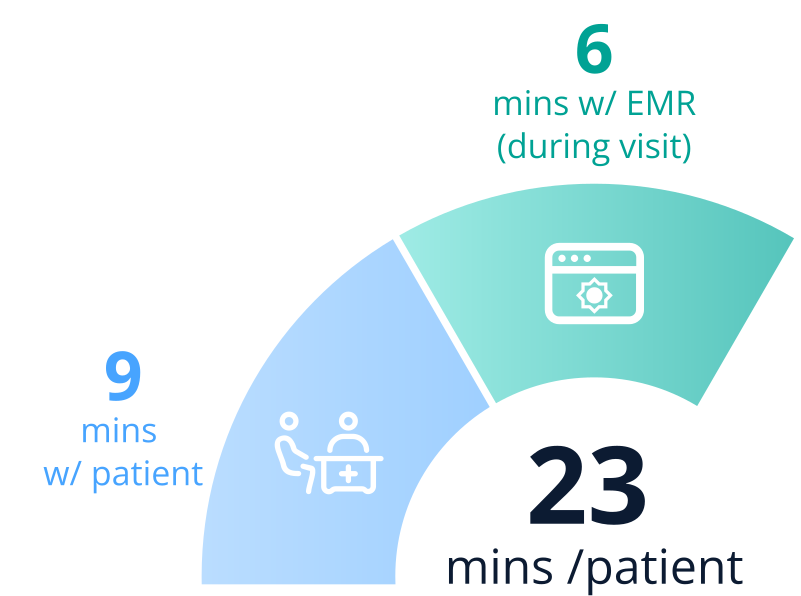
Of those 15 minutes, 9 go to the patient and 6 go to the EMR, while the physician listens, reasons, examines, and documents all at once. These tasks compete for the same limited cognitive bandwidth, and the cost compounds:
- Cognitive load escalates. High-stakes reasoning runs alongside clerical input, ergonomically and neurologically inefficient.
- Patient connection weakens. Patients notice when attention shifts to the keyboard.
- Documentation quality declines. Notes written under divided attention and time pressure could lose nuance and completeness.
What looks like 6 minutes of EHR interaction is, in practice, a continuous attentional strain running through the entire consultation.
BUCKET 2 • AFTER THE VISIT • 8 min/patient
The invisible work, the “pyjama time”
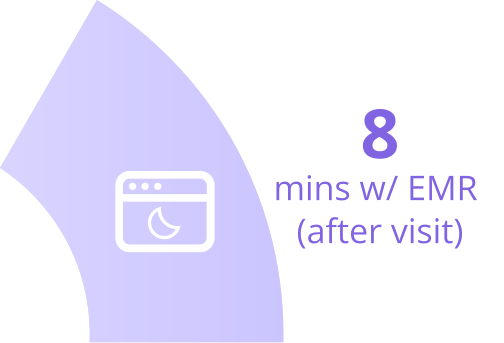
An additional 8 minutes per patient accumulates after the encounter ends: between patients, over lunch, and often after hours:
- Finalizing clinical notes. Charts started during the visit rarely close before the next patient. The backlog follows physicians home.
- Prescription renewals. Each pharmacy request needs chart review, clinical judgment, and documentation.
- Lab result management. Normal results must be classified; abnormal ones need annotation, follow-up, and communication.
- Referrals & forms. Specialist consults, insurance, disability, and provincial compensation paperwork pile on.
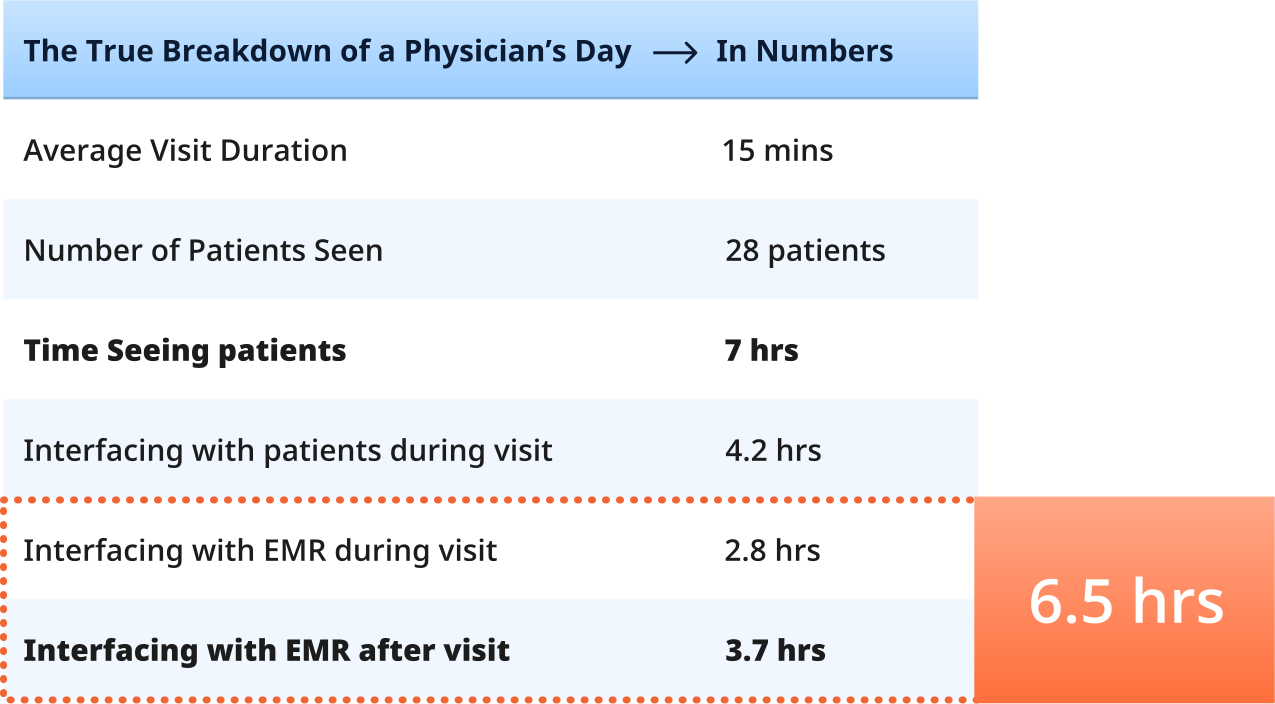
Eight minutes may not sound like much. But multiplied across 28 patients a day, it becomes more than 3.7 hours of additional cognitive work. Much of it after clinic hours, and much of it feeding directly into exhaustion. To put a number on what those recoverable hours are actually worth, The 3 ROI Dimensions That Matter Most for Canadian Clinics breaks down the real economics of a clinic.
Put differently: of the 23 minutes spent per patient, 14 minutes are recoverable. That’s the share tied up in interacting with the EMR and coordinating care. This is the work that a smarter, built-in approach can give back without cutting a single minute of face-to-face.
BEYOND TIME AND COST
The Cognitive Burden Is the Heaviest Load Physicians Carry

The cognitive load physicians carry is not just “busy,” it is uniquely relentless. They are expected to deliver empathy, diagnostic reasoning, and risk management in real time while simultaneously running a complex administrative operating system in their heads. During the visit, they are listening for subtle clinical signals, weighing differential diagnoses, and making safety critical decisions, all while managing interruptions, time pressure, and the need to translate a nuanced conversation into structured documentation. That constant context switching between clinical thinking and clerical execution is mentally expensive, and it is one reason many physicians describe the workday as exhausting even when the schedule looks “manageable” on paper.
The Canadian data confirms all of this: According to the results of the CMA’s 2025 National Physician Health Survey, 46% of physicians reported high levels of burnout, and they reported spending an average of 10.4 hours per week on administrative tasks , with 64% spending a considerable amount of time in EMRs outside of regular hours.⁵ Other national data on administrative burden also show that 64% of respondents report spending an excessive or moderately high amount of time on electronic medical records outside regular working hours.⁶ In health care, the volume of downstream paperwork is so significant that it has been estimated at 19.8 million hours per year, further reducing the time available for attention and recovery and increasing the risk of burnout.⁷
In summary, the problem breaks down into four connected effects. Cognitive fragmentation reduces clinical depth. When attention is split, the connection with patients erodes. Administrative backlog pushes work into evenings and weekends. And persistent overload accelerates burnout.
Cognitive fragmentation
reduces clinical depth.
Divided attention
erodes the connection with patients.
Administrative backlog
drives work into evenings and weekends.
Persistent overload
accelerates burnout.
AND IT ISN’T ONLY PHYSICIANS
The front desk is at a breaking point too
The 23-minute problem is what a physician feels. But it sits on top of a second front: the administrative engine that keeps a clinic running. The volume has outgrown the people available to handle it.
~12,000
Calls per month. Incoming and outgoing: scheduling, reminders, follow-ups.⁸
~6,000
Documents per month. Received by fax or mail: lab results, imaging, reports and forms, all triaged by hand.⁸
1:1
One administrative agent per physician. On average, it takes one medical office assistant per physician to keep up with the admin load.⁸
+43,000
Roles to fill by 2033
Administrative positions Canada will need to fill by 2033, in a market where they’re already hard to retain.⁹
Holding that administrative engine together without sacrificing the clinic’s viability is exactly what Christopher Fisher digs into on the Reimagine Healthcare podcast, in Can Clinics Survive Without Thinking Like a Business?

KEEP READING
This is the administrative engine sitting beneath the 23-minute problem, and it carries a weight of its own. We break down what a single clinic holds together each month, call by call and document by document.

ON THE PODCAST
On the Reimagine Healthcare podcast, Dr. Julie Wilson, founder of one of British Columbia’s largest primary care networks, makes the case that easing this load does not mean fewer people. It surfaces the care that was quietly going undone, the appointment never booked, the screening that slipped by, and gives teams the room to finally reach it.
A STRUCTURAL PROBLEM, NOT A DOCUMENTATION ONE
Technology that sits beside the workflow will keep fragmenting it
The 23-minute problem isn’t really about documentation time. It reflects a structural misalignment between how medicine is practiced and how digital tools are designed. Most clinics have tried to fix it by layering on new tools: a scheduling add-on here, a connected AI scribe there. But layering technology rarely solves structural inefficiency. It adds complexity, cost, and fragments workflows further.
The future of care doesn’t depend on adding more digital layers. It depends on rebuilding the workflow so technology restores focus instead of splitting it. MYLE all-in-one EMR platform can give physicians back what matters most: time with their patients, and the mental space to reason well.
Want to see what this looks like in
your clinic?
In clinics using MYLE today, physicians are cutting hours of EMR time every week, without adding a single extra hour of work to their schedule.
Talk to an expert to map your current day and see how much time you could reclaim.

Sources
1. Canadian Medical Association. Administrative Burden is Driving Physician Burnout. CMA.ca, 2024. cma.ca/our-focus/administrative-burden
2. Kiran T, and al. OurCare National Survey, 2022. OurCare Initiative, Unity Health Toronto. ourcare.ca/survey
3. Canadian Institute for Health Information. (2026, April 23). Use of digital communication tools and AI among family doctors. https://www.cihi.ca/en/understanding-family-doctors-well-being-insights-from-canada-and-international-peers/use-of-digital-communication-tools-and-ai-among-family-doctors
4. Stanford Medicine. How Doctors Feel About Electronic Health Records (EHR Poll Presentation), 2023. https://med.stanford.edu/news/insights/2018/06/poll-doctors-say-electronic-health-records-need-overhaul.html
5. Canadian Medical Association (2025). From pressure to progress: Results from the CMA’s 2025 National Physician Health Survey. https://www.cma.ca/latest-stories/pressure-progress-results-cmas-2025-national-physician-health-survey
6. Canadian Medical Association (2025). Five years since the onset of COVID-19, Canada’s physicians still suffer a high rate of burnout. https://www.cma.ca/about-us/what-we-do/press-room/five-years-onset-covid-19-canadas-physicians-still-suffer-high-rate-burnout
7. Canadian Medical Association. Administrative burden. cma.ca/our-focus/administrative-burden
8. MEDFAR internal study
9. Employment and Social Development Canada. (2025, January 30). Medical administrative assistants (NOC 13112): Canadian Occupational Projection System (COPS), 2024–2033. Government of Canada.