
Running a medical practice today requires much more than delivering excellent patient care. Behind every appointment, prescription and referral is a complex network of administrative work that must be managed accurately, consistently and under real time pressure. Yet, the work that keeps clinics functioning smoothly is often overlooked, undervalued and chronically under-resourced.
For family physicians and specialists alike, administrative burden is more than a task list. It is one of the main drivers of burnout and a significant drag on clinic efficiency and finances. Canadian physicians spend millions of hours each year on unnecessary administrative tasks, a pressure that contributes to burnout and limits access to care. [source]
Scale is easy to underestimate. Keeping up with that work takes, on average, one administrative professional for every physician in the clinic*.
There’s a growing case that the fix is structural rather than just working harder, a tailored approach to technology can streamline much of this workflow and hand time back to care.
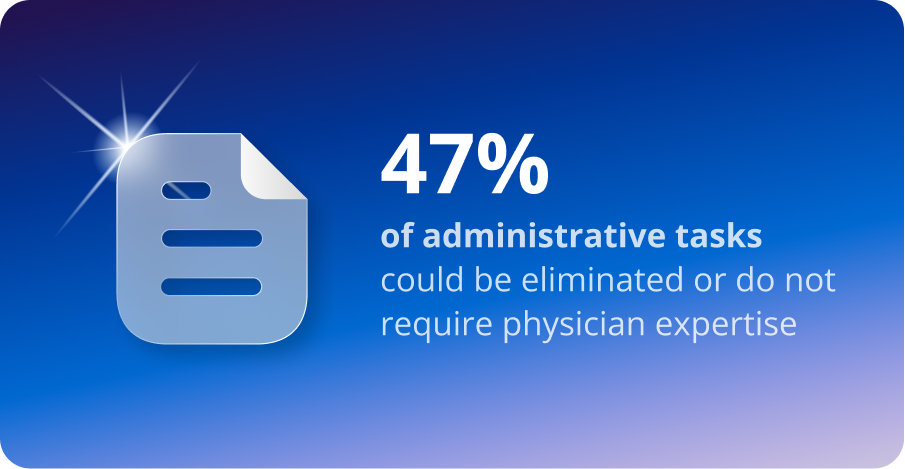
Admin Work Is Human-Intensive and Highly Complex
Medical administrative work in a clinic setting encompasses a broad range of duties that require precision, judgment and excellent interpersonal skills. Typical responsibilities include:
- Managing patient scheduling, reminders and check-in
- Handling phone calls, secure messages and patient follow up
- Processing referrals, prior authorizations and clinical forms
- Preparing charts and scanning records
- Coordinating results, renewals and task assignments
- Managing billing, coding and insurance claim submissions
These are not rote tasks. They require decision making, familiarity with medical terminology, familiarity with compliance requirements and often direct interaction with stressed or vulnerable patients and caregivers. Turnover in these roles disrupts continuity, increases error rates and reduces both patient satisfaction and clinic revenue. [source]
Two Tasks Carry Most of the Load
Of the responsibilities above, two consume more of the day than any other: the calls coming in and going out, and the documents arriving by fax and mail. To see why the workload feels relentless, it helps to look at a single clinic. In a group practice of 16 physicians, keeping pace with the administration takes roughly 16 administrative professionals, one alongside each physician. Here is what those teams hold together every month.
Calls: Close to 12,000 a month
In that 16-physician clinic, the phones carry close to 12,000 calls a month, around 3,000 a week*. Each one is an appointment to book, a reminder to give, a follow up to close or a patient looking for an answer, each tends to arrive while others are already waiting.
Divided across the practice, that is roughly 750 calls tied to every physician, every month, fielded by a team that is also welcoming patients at the front desk, updating charts and preparing for the next visit. Moving between the voice on the phone and the person standing in front of them, over and over, is one of the most draining and least visible parts of the day.
The calls also outlast clinic hours. At peak times and after the doors close, some go unanswered, and each missed call becomes a patient still waiting, a callback added to the queue and a list that is already longer by morning.
🎧 ON THE PODCAST
Dr. Julie Wilson, founder of Terra Nova Medical Clinics, one of British Columbia’s largest primary care networks, puts this volume in a different light on our recent episode of the Reimagine Healthcare podcast. In her view, helping a team keep pace with the phones does not remove roles. It reaches the calls, and the care behind them, that were never getting answered in the first place.

Documents: 6,000 a month for 16 physicians
Then there is documentation. Roughly 6,000 documents reach the clinic every month by fax and mail*: lab results, imaging, specialist reports and clinical forms, each one read, sorted, labelled and routed to the right chart by hand. For those same 16 physicians, that works out to about 375 documents landing behind each one, every month.
Keeping that flow moving takes around 1.5 full-time people doing only indexing. And even then, a document takes an average of 2.5 days to reach the physician it was meant for. Results and reports stack up in the interval, and that lag can reach the exam room before anyone catches it.
The sorting is exacting, too. Two of every five documents, close to 2,400 a month, either need correcting or turn out to be hard to find again later. A single fax becomes a small chain of work: track it down, fix it, re-file it, confirm it reached the right place. Set against thousands of pages a month, the real cost of what looks like simple filing comes into focus.
These two tasks alone create nearly 18,000 administrative touchpoints every month, and that’s before counting referrals, authorizations, or billing. This essential work keeps clinics running, yet it is rarely acknowledged or fully understood.
The Workforce Shortage and Turnover Challenges
Across Canada, healthcare jobs have rebounded and demand is rising. The healthcare sector saw over 96,000 unfilled positions in health occupations in late 2022, indicating a systemic shortage that affects frontline clinical jobs as well as administrative roles. [source]
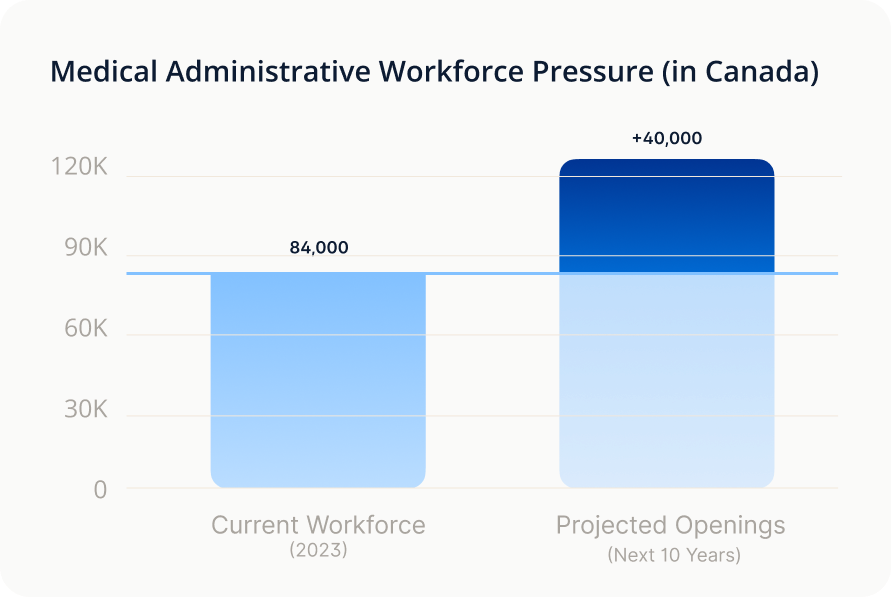
Medical administrative positions are large in number, with roughly 84,000 workers in 2023, and more than 43,000 positions expected to open across the coming decade, through 2033. [source] This growth reflects replacement of departing workers as much as expansion, as older administrative staff reach retirement age.
Although Canadian data does not break out turnover rates for medical office assistants specifically, studies from broader medical practice settings indicate that administrative and billing support roles experience significant instability and turnover, with total replacement costs for a frontline support hire estimated at $25,000 to $30,000 per role. [source]
This turnover is costly for clinics, disrupting workflows, reducing morale and increasing time spent on recruitment and training.
Why Finding and Training Staff Is Hard
Even before hiring and compensation costs, clinics face structural challenges in attracting qualified administrative professionals. Medical office assistants must combine a rare blend of skills:
- Clinical administrative competence
- Computer and electronic health record proficiency
- Communication and conflict resolution skills
- Scheduling and multitasking ability
- Familiarity with medical regulations and documentation
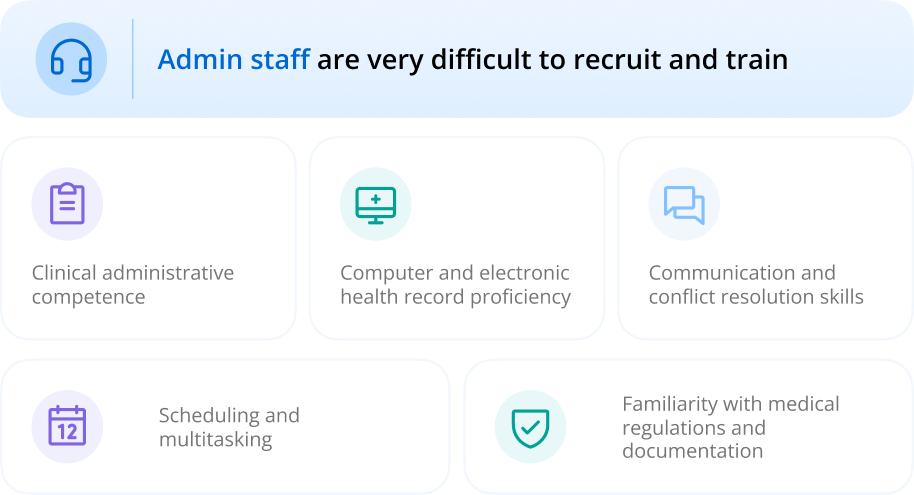
Those skill sets are not easily found in entry level applicants. Training new staff requires supervision, back-up coverage for day-to-day operations and dedicated time from experienced team members, work that is not billable, yet essential for clinic performance.
Administrative Overhead Is Draining Physician Earnings
Administrative staffing is one of the largest expenses in private medical practices and represents a significant portion of physician overhead. Across Canada, physician practices incur costs for rent, staff, equipment and supplies that consume a significant share of gross clinical earnings. [source]
For example, on a typical gross income of $330,000, roughly $75,000 may never reach the physician because of overhead:
- Roughly 25K dollars goes to rent, IT, office and medical supplies.
- Another 50K dollars goes to staff needed to manage the growing administrative load.
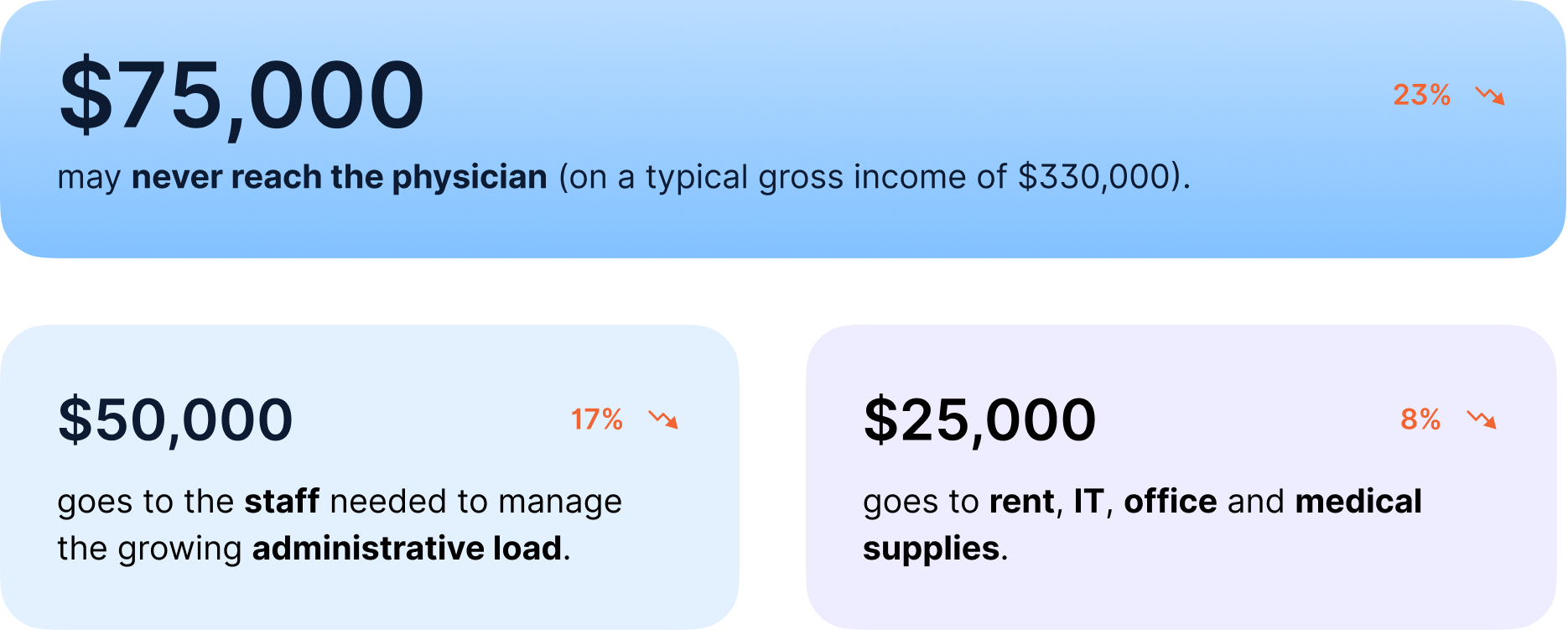
This means that close to 23% of clinical revenue goes to overhead, with staff costs accounting for the largest share. Even at these levels, qualified staff are hard to retain and train. [source]
For a closer look at where that overhead actually goes and how clinics weigh the return on it, The 3 ROI Dimensions That Matter Most for Canadian Clinics breaks down the economics behind these numbers.
In broader practice expense research, medical office operating costs across practices can range from 60% to 70% of annual revenue, with staff compensation often being the largest category. [source]
Why This Matters
Administrative work is not a luxury. It is a core function that directly affects:
- Patient access and satisfaction
- Physician time available for clinical work
- Revenue cycle accuracy and cash flow
- Compliance with regulatory requirements
- Clinic sustainability

Without skilled administrative professionals, clinics risk delays in care, billing errors, loss of revenue and increased physician burnout. Yet these roles are also among the most prone to turnover and vacancy within clinical settings, creating a vicious cycle where staffing instability drives further workload and stress.
Conclusion
Modern medical clinics rely on administrative professionals to keep operations running. These super-human multitaskers carry immense responsibility and require both experience and adaptability that cannot be replaced. At the same time, the workforce shortage and turnover in these roles come with costs in both dollars and quality of care.
The tension between running a financially viable practice and protecting quality of care is exactly what Christopher Fisher digs into on the Reimagine Healthcare podcast, in Can Clinics Survive Without Thinking Like a Business?
Unless the systemic issues of recruitment, training and compensation are addressed, the administrative backbone of Canadian healthcare will remain stretched, with costs rising and efficiency declining. Investing in better support systems, clearer career pathways and sustainable workloads is not just good practice management. It is essential to improving patient care and physician wellbeing.
*Call and document volumes, indexing load, turnaround time and the one-administrator-per-physician ratio are based on MEDFAR’s analysis of a representative 16-physician primary care clinic. Figures vary by clinic size and staffing model.

Make Your Life Easy
Designed for Canadian primary care clinics. Built to support clinician retention, workflow efficiency, and sustainable access.