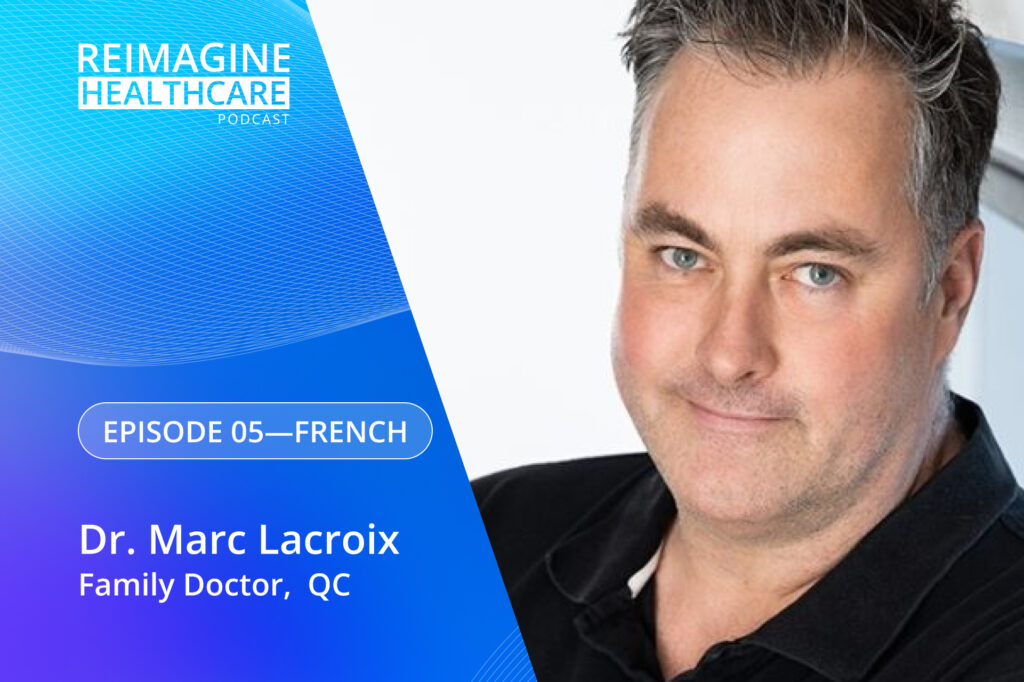
The Reimagine Healthcare Podcast with Dr. Marc Lacroix
Note: This podcast episode was recorded in French.


Dr. Marc Lacroix spent more than 10 years working in emergency departments across 40 healthcare facilities, a career that involved overnight flights, weekend shifts, and Christmases away from home. Over the years, one reality became increasingly clear: the healthcare system leaves less and less room for the time doctors need to truly focus on their patients.
Most doctors eventually resign themselves to it. Dr. Marc Lacroix did the opposite. In 2009, he opened one of Quebec’s first private clinics in Lac-Beauport. Seventeen years later, his group counts 15 points of service, roughly 350 employees, nearly 130 physicians, and average growth of 30% per year.
In this episode of the Reimagining Healthcare podcast, Dr. Marc Lacroix, president and founder of Groupe Lacroix, recounts how he went from emergency physician to healthcare entrepreneur, and why he bet his career on a simple idea: time spent with the patient.
It all starts with an observation made in the field. In practice, fee-for-service payment pushes doctors to see 10, 15, sometimes 18 patients an hour. Under those conditions, it’s impossible to focus on prevention, to examine, to listen. Dr. Lacroix designed a model where the appointment lasts 30 or 60 minutes, where you get a response within 24 hours, and where the patient once again becomes the center of the decision.
What follows is a conversation about the birth of the private sector in Quebec, about the real economics of care and about two-tier medicine, and about what no one dares to say out loud: the public system can no longer afford to offer everything for free.
Key Topics
- From the ER to private practice
- A model built on time with the patient
- Growing a network of 15 clinics
- AI and legislative challenges
- Public or private: the debate over access to care
Key Takeaways
The breaking point wasn’t a crisis, it was an accumulation
No dramatic moments. Rather, ten years of wear and tear. Always in the regions, always on a plane, always working weekends and holidays. Dr. Lacroix describes a system he saw as “deflated,” disconnected from its primary vocation: to heal.
What tipped him over was the practice model itself. Fee-for-service payment, he says, creates a perverse effect: it rewards volume, not quality.
“I won’t see 10 patients an hour. I wanted time with my patient, and the public model wouldn’t allow it. So I invented my own.”
Translated from French
Time is the real product
The model comes down to one phrase: buy time, not privileges. An appointment within 24 hours, but above all a consultation of 30 or 60 minutes. Enough to examine, to ask questions, and to address prevention rather than just the day’s presenting complaint.
It’s a lesson brought back from the regions, where he had learned to take his time with his patients, notably among the Indigenous communities of the Côte-Nord.
It was the patients who asked to pay
Dr. Lacroix worked for six months without pay, allowing patients to reserve a spot at his clinic with a deposit. Demand quickly exceeded his expectations. When annual memberships, averaging $1,000, were eventually introduced, approximately 400 people signed up and paid for a membership.
“It was the patients themselves who called me to say: we want to become members of your clinic, can we pay?”
Translated from French
The elite myth doesn’t hold up
Contrary to the image portrayed, his clientele was not wealthy. Not millionaires, not hockey players. Middle-class people from all over Quebec, from the Gaspé to the Saguenay–Lac-Saint-Jean, who decided that their health deserved the same care as a visit to the dentist.
“This isn’t elite medicine. It’s an offering that probably speaks to 75 or 80% of the population.”
Translated from French
Attacked from day one, and ready for it
On opening day in Lac-Beauport, he had invited the media. Within 24 to 48 hours, the story had gone province-wide, and so had the attacks. Rather than defend himself, he chose to open a dialogue.
His argument: the private sector is not first and foremost about money, it’s about time. Once that idea is understood, he says, the taboos fall away.

On The Reimagine Healthcare Podcast, we explore how healthcare leaders across Canada are building smarter, more human systems of care, through innovation, technology, and better workflows.

Going from physician to executive, the counterintuitive decision
Letting go of the stethoscope for management is far from natural after more than ten years of university. Dr. Lacroix believes he is one of the few in Quebec to have almost entirely left practice to lead. Today he practices at about 10%.
The turning point was partnering, in 2016, with Alexandre, a profile that complemented his own. The doctor describes himself as an entrepreneur “more red than blue”: visionary, but weaker on structure and management.
“You can’t do 50 hours of medicine a week and 50 hours of management. Otherwise, you get sick.”
Translated from French
This balance between running a viable business and protecting the quality of care is exactly what Christopher Fisher explores on the Reimagining Healthcare podcast, in Can clinics survive without thinking like a business?
Growing through acquisitions to cover the province
The second clinic, in Cap-Rouge in 2011, was a gamble: he opened it without a physician, staffed by nurses, before recruiting two family doctors the following summer. Then growth accelerated through acquisitions. The purchase of Avenir MD in Montreal in 2016 nearly doubled the group and anchored it in the western part of the province. Sentinelle Santé, in the Gatineau area, pushed the network further still.
On how to build a clinic network at scale, Dr. Julie Wilson recounts her own journey in Scaling Family Medicine: How Dr. Julie Wilson Built a Clinic Network for the Modern Practice.
A group with three divisions
In 2026, Groupe Lacroix is structured around three divisions.
1. The clinic, with roughly 130 physicians, split evenly between family medicine and specialties, as well as a growing number of nurse practitioners (NPs).
2. Surgery, with two surgical facilities in Laval and Quebec City, offering primarily same-day surgery, as well as procedures in orthopedics, spinal neurosurgery, general surgery, gynecology, ENT, and bariatric surgery.
3. Diagnostic services, including accelerated laboratory testing performed at its dedicated biomedical facility in Quebec City.
The metrics that really matter
Revenue gives the pulse of growth, but Dr. Lacroix mainly tracks three things:
1. Satisfaction. Around 95%, with a money-back guarantee since day one: a dissatisfied patient is refunded.
2. Complications. In the operating room, the target is zero, or as close as possible.
3. Turnaround times. A goal of appointments within 24 hours, supported by an in-house call center.
Artificial intelligence: still early, but no fear
According to its president, Groupe Lacroix is still in the early stages of integrating artificial intelligence. However, AI is already part of the management teams’ day-to-day work, supporting areas such as recruitment, writing job descriptions, salary benchmarking, and operational planning.
His view is that AI is only as good as the preparation behind it. Asking the right questions takes upstream work.
“Artificial intelligence will help us do more with less and make better decisions.”
Translated from French
On this transformation already underway, Dr. Samuel Gareau-Lajoie explores what AI concretely changes in daily practice, on the podcast, in Medicine and artificial intelligence: a revolution already underway.
An observation MEDFAR shares: where the goal was to make medical teams 15 to 20% more efficient a few years ago, today’s AI pushes that gain to 40 to 60%.
The real obstacles aren’t clinical; they’re political
What worries Dr. Lacroix isn’t demand, it’s regulation. He cites Act 83, which limits the recruitment of new physicians in the private sector, and the medical staffing plans, which restrict physician mobility and force new graduates to set up where the system decides.
These constraints push him to look elsewhere: Alberta, where a more flexible framework allows practicing in both the public and private sectors, and even the northern United States.
Two-tier medicine already exists
On the most delicate debate, Dr. Lacroix doesn’t dodge. Two-tier medicine is not a future threat, he says; it’s an established reality: more than 100,000 people a year leave Canada to be treated elsewhere. His argument: better to keep that money, those taxes and those patients here.
His distinction is clear. What must stay public is the financing of care, not necessarily the party that delivers it.
“Whether public or private, if care is high-quality, fast, and the patient is at the heart of the decision, there’s no problem.”
Translated from French
“When things go wrong and your life is on the line, time becomes your enemy. […] There’s a cost to waiting.”
Translated from French
Making the money follow the patient
Dr. Lacroix proposes tax compromises rather than new spending. Making a private surgery tax-deductible, or covering part of it, would cost the state less than performing it itself, while democratizing access. The principle, borrowed from “value-based care” and Scandinavian models: know the cost per episode of care and fund facilities according to their performance, not their budget history.
“Health insurance should pay the patient, not just the facility. The money must follow the patient.”
Translated from French
To understand where the money really goes in a clinic, The 3 ROI Dimensions That Matter Most for Canadian Clinics breaks down the numbers behind clinic economics.
What’s strangling the public system
When it comes to bottlenecks in the public system, Dr. Lacroix points to a different set of underlying challenges:
- Hyper-centralization. Santé Québec makes dialogue difficult, even for a structured organization.
- Money that doesn’t follow the patient. Budgets are renewed by history, not by the number of patients treated.
- Unionization and rigidity. They remove the agility needed to adjust quickly.
- Licensing. He points in particular to the restrictions around obtaining a radiology licence for a clinic, stemming from regulations introduced in the late 2000s, even when clinics serve a high volume of patients.
Beyond structure, Dr. Lacroix insists above all on continuity: reorganizing the org chart with every new government exhausts the system. Health should be planned over 20 or 25 years, not on a four-year electoral cycle, and the real work is in execution and good metrics.
This vision of a more decentralized and more human system, built as close to the patient as possible, aligns with the one Dr. Frédéric Picotte defends in Building the health of tomorrow, from the ground up.
Conclusion
Dr. Marc Lacroix’s story isn’t first and foremost one of private versus public. It’s the story of a doctor who refused a model where time no longer exists, and who built the alternative brick by brick.
Behind the ideological debate lies a more concrete question: how can a system running out of breath keep the patient at the center? Dr. Lacroix’s answer blends clinical time, performance metrics, technology and courage. His solutions may be debated, but the challenges he identifies raise broader questions about how to keep patients at the center of care.
🎧 Listen to the full episode
Listen to the full episode of the Reimagining Healthcare podcast to hear Dr. Marc Lacroix’s complete conversation on the birth of the private sector in Quebec, the real economics of care, and the future of access to care.

Make Your Life Easy
Designed for Canadian primary care clinics. Built to support clinician retention, workflow efficiency, and sustainable access.