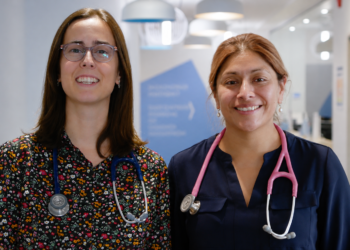
The Reimagine Healthcare Podcast with Julie Deslauriers
Note: This podcast episode was recorded in French.


Quebec’s primary care system is under growing pressure. Patient needs are increasing, healthcare teams are stretched thin, and significant changes are taking shape, even as many details about how they will be implemented remain unclear.
For Julie Deslauriers, the answer is not simply to ask more of already overextended teams. She believes the path forward is different: work better together, reduce unnecessary burdens, and create the conditions teams need to continue delivering high-quality care over the long term.
In this episode of the Reimagining Healthcare podcast, Julie Deslauriers, a nurse by training and now Vice-President of Clinical Operations at GSE (Groupe Santé Expert), reflects on what she has learned over 20 years in primary care. Today, she oversees operations across 13 GMF and two specialized clinics in neurology and pediatrics. She describes each of these settings as a small business in its own right, with its own realities, pressures, and challenges.
The daughter of an emergency room nurse and a fisherman, Julie sees herself as a blend of both: her mother’s instinct to care for others and her father’s entrepreneurial spirit. That combination took her from a research lab in her twenties to leading a network of clinics, guided throughout her career by a willingness to say yes to the next opportunity.
The conversation explores burnout in primary care, the trust required to lead teams through change, and an increasingly important reality: the future of family medicine depends less on a single physician and more on the ability of healthcare teams to work together around the patient.
What was discussed
- Why “work better, not more” is the only sustainable answer to burnout in primary care
- The hidden cost of the 2017 abolition of incidental fees, and why some clinics moved services into the private sector to keep them available
- What 8,000 documents a week does to a family physician’s workload, and how to tame it
- Why EMR adoption succeeds through clinical champions, not top-down directives
- The performance indicator most clinics ignore: team morale, alongside the numbers
- What primary care reform changes for the doctor-patient relationship
- Why “the patient gains a team” is more than a slogan for physicians
- Using personality tools like Nova Global to build clinical teams that truly work
- How AI scribes are already changing the atmosphere of medical consultations
- The line between AI that saves time and AI that accelerates an already frantic pace
- How to build enough trust that clinicians will admit they need help
- Preventing burnout among health leaders: naming your own warning signs
- the communication gap between the Ministry and frontline teams, and how to close it
- A 10-year vision: team-based care, patient responsibility, and rebuilding collective trust

On The Reimagine Healthcare Podcast, we explore how healthcare leaders across Canada are building smarter, more human systems of care, through innovation, technology, and better workflows.

Key Takeaways
A Nurse Who Never Followed a Predetermined Path
Originally from the Gaspé Peninsula, Julie Deslauriers became a nurse because of her mother, who spent her entire career in healthcare without ever waking up dreading the day ahead. Julie’s own career, however, quickly took an unconventional path.
After completing her bachelor’s degree, she moved into research. Then, in 2006, at the age of 26, she joined Clinique Saint-Louis alongside two physicians she describes as visionaries. Ten years later, she was asked to manage a rapidly growing clinic. She said yes, just as she says she has throughout her career.
She attributes some of that willingness to take risks to her father, a fisherman for whom every morning at sea brought a new adventure. Twenty years later, Julie now oversees medical operations across a network of 13 GMF and two specialized clinics.
“It’s often the encounter that makes you become the person you are. I really met wonderful people who brought me to where I am.”
Translated from French
The Elimination of Incidental Fees and the Reorganization of Certain Services
In 2017, Quebec’s elimination of incidental fees changed the way some services could be delivered within GMF. Clinics could no longer charge patients certain fees used to help cover costs related to blood draws, nursing staff, or medical supplies.
But for Julie Deslauriers and her colleagues, patients’ needs had not disappeared. Their response was to move certain services outside the GMF structure and offer them in a private setting, allowing them to continue funding those services and keeping them available to patients.
The goal, she explains, was first and foremost to preserve services patients had come to rely on but that could no longer be financially sustained in the same way within the GMF.
“The next day, patients who used to get their blood work done at our place couldn’t anymore, because we couldn’t support it financially. So we privatized so we could pay our staff and keep the service.”
Translated from French
Primary Care Is Running Out of Steam
For Julie Deslauriers, the reality is clear: patient needs are increasing at a time when primary care teams are already under significant strain. The population is aging, cases are becoming more complex, and healthcare professionals are facing increasingly heavy workloads.
In that environment, simply asking teams to do more cannot be the answer. The more important question is how they can work better: collaborate more effectively, distribute responsibilities more appropriately, and remove unnecessary burdens while protecting both the quality of care and the people delivering it.
“I think we have to think about working better, because yes, the teams are out of breath. If we do nothing, we’ll blow out primary care.”
Translated from French
Kindness as a Driver of Collaboration
In organizations under pressure, the quality of working relationships becomes a genuine performance issue. For Julie Deslauriers, communication, mutual support, and kindness are not secondary considerations. They directly influence a team’s ability to stay engaged, work together effectively, and navigate periods of change.
It is an important reminder that in healthcare, where operational pressures are intense and teams are constantly being asked to adapt, effectiveness is not only about processes. It also depends on the environment in which professionals are expected to work together.
“If each of us were a little more benevolent with the people around them, I think we could make major changes.”
Translated from French
From Paper to Digital: 8,000 Documents a Week
Julie Deslauriers has lived through every stage of healthcare’s digital transition: from paper charts to EMRs, and then from one EMR to another.
She remembers a time when full-time staff members did little more than pull paper charts for the following day’s appointments. The transition to digital happened quickly, in less than a decade. And in her experience, it was not top-down directives that drove adoption. It was the clinical champions who embraced new tools early and then helped their colleagues adapt.
But digitization did not eliminate one of the biggest challenges facing clinics: the sheer volume of information that has to be processed.
During the episode, the conversation touches on an average of roughly 8,000 documents received by a GMF every week. Lab results, prescriptions, faxes, mail, and information arriving through multiple channels all have to be matched to the right patient record and reviewed by the appropriate team members.
Trust Is Built When Someone Feels Comfortable Raising Their Hand
In 2021, Julie Deslauriers moved from clinic manager to director, suddenly expanding her responsibilities across several clinics.
Her first and greatest challenge was not operational. It was human: getting to know the teams, allowing them to get to know her, and building enough trust for everyone to work effectively together.
People who spend their days helping others can sometimes find it especially difficult to ask for help themselves. For Julie, the moment a team feels comfortable doing so is one of the clearest signs that genuine trust has been established.
“When people are able to raise their hand and say, Julie, I think we need help, I tell myself: I’ve succeeded. Because someone who asks you for help is someone who trusts you.”
Translated from French
Know Yourself, Then Work as a Team
In 2025 and 2026, Julie Deslauriers earned certifications with Nova Global, a tool for understanding personality and preferences. She put all her managers through it. The logic is simple: the better people understand themselves and each other, the better they collaborate, because they can name their limits, their needs, and their commitments.
The exercise also revealed her own blind spots. Her favorite lesson is a discipline she now applies to every irritation.
“When something irritates you, always ask yourself what need, in that moment, isn’t being met.”
Translated from French
When Performance Is About More Than Metrics
For Julie Deslauriers, the health of a clinic cannot be measured through operational indicators alone. Visit volumes and patient numbers matter, but they only tell part of the story.
The state of the team matters just as much.
A clinic can look highly successful on paper while operating in an environment where professionals are disengaged, under pressure, or struggling to work effectively together. True performance therefore requires a balance between measurable outcomes and the strength of the team behind them.
Julie is clear about what this means for the future. As primary care continues to change, the clinics best equipped to adapt may not necessarily be those with the strongest metrics. They may be the ones whose teams know how to work together.
This search for balance between a clinic’s viability and the quality of care also echoes another episode of Reimagining Healthcare, in which Christopher Fisher raises a central question: Can Clinics Survive Without Thinking Like a Business?
“I can have a very high performing clinic on paper, but morale is at zero when you walk in. The clinics that will stand out are the ones able to work as a team.”
Translated from French
A Reform No One Fully Understands Yet
One of the biggest challenges in the months ahead will be helping primary care teams navigate the changes now taking shape.
Several aspects of the reform are still evolving, leaving clinics to move forward without always knowing exactly what the final model will look like.
For Julie, the focus is therefore less on the rules themselves and more on how teams will experience the transition. Beyond new requirements and organizational changes, the challenge will be to preserve their engagement, their ability to collaborate, and their confidence in what comes next.
“The patient will lose his family doctor, but he’ll gain a team. It’s not a doctor who follows you, it’s a team that follows you.”
Translated from French
This same vision of collaboration at the heart of healthcare is shared by Dr. Sienna Bourdon in the Reimagining Healthcare episode exploring Inside Shoreline Medical’s Collaborative Healthcare Model.
Julie has confidence in her teams. Because GSE has invested in developing its people, she believes they are better prepared than most to sit down together, challenge one another, and find solutions that work locally.
Taking Care of Others Without Losing Sight of Yourself
Julie Deslauriers runs and is currently training for the Baie-des-Chaleurs half-marathon. She also sees a psychologist, something she considers particularly important for people in management roles who carry significant responsibility.
Over the years, she has learned to recognize her own limits and the warning signs she needs to pay attention to.
In a field where so much energy is devoted to caring for others, protecting your own well-being becomes essential.
Her advice to anyone who feels overwhelmed is strikingly simple: be willing to ask for help.
AI Should Give Clinicians Time Back, Not Simply Make Them Work Faster
Julie Deslauriers approaches artificial intelligence with both enthusiasm and a healthy sense of caution. In her view, AI is already making its way into clinics, and its role will only continue to grow.
Its value becomes especially tangible when it gives time back to healthcare professionals.
AI scribes, for example, can reduce the amount of attention physicians have to devote to documentation during a consultation, allowing them to focus more fully on the patient in front of them.
The real question is what teams choose to do with the time they gain.
If AI is used only to further increase the pace of work, some of its value may be lost. Instead, Julie believes that time should be reinvested in the patient relationship and in the aspects of care that remain fundamentally human.
The integration of AI into healthcare is no longer a distant prospect, a topic Dr. Samuel Gareau-Lajoie explores in depth in another episode of Reimagining Healthcare: Medicine and Artificial Intelligence: A Revolution Already Underway.
“What worries me is that we’ll use it to speed up a pace that’s already too fast. I hope the time we save gets reinvested in the patient and in the human.”
Translated from French
Conclusion
What stands out from this conversation is that the future of primary care will not depend solely on reforms, technology, or new models of care. More than anything, it will depend on clinics’ ability to absorb these changes without losing what makes high-quality care possible: teams that can collaborate, trust one another, and remain close to their patients.
From that perspective, technology only creates value when it genuinely makes the work easier, and organizational change only matters if it helps teams function better.
Real progress, then, should not be measured solely by how much more clinics are able to do, but by how much better they are able to do it.
Perhaps that is the strongest idea Julie Deslauriers brings to this conversation: transforming primary care is not simply about asking it to adapt. It is also about giving it the conditions it needs to evolve sustainably.
🎧 Also worth a listen
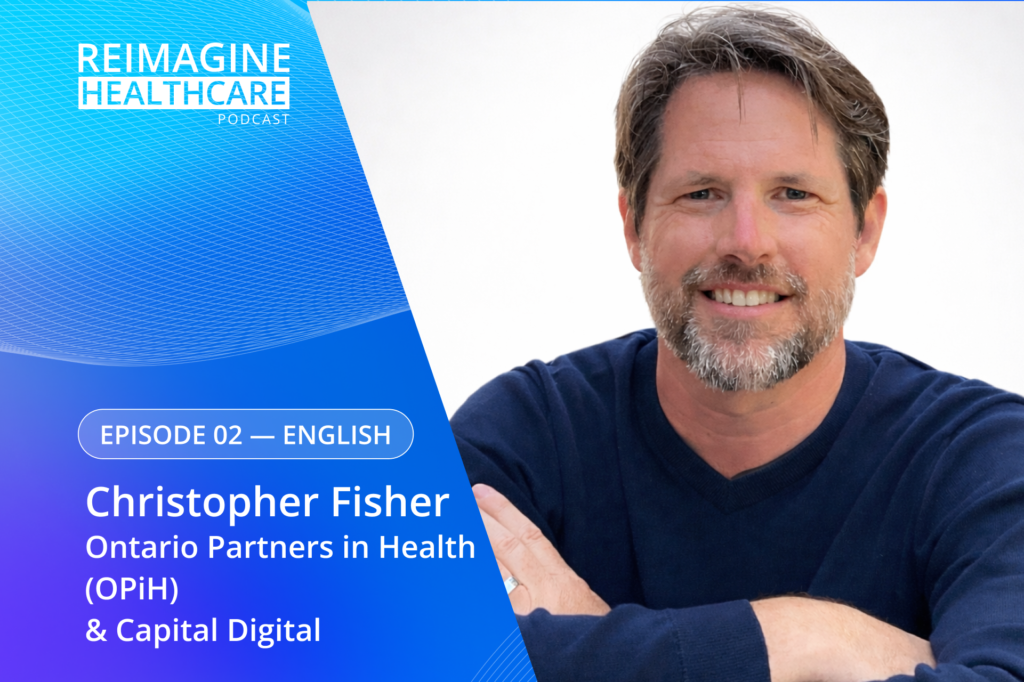
If this topic caught your interest, you might also enjoy episode 1 of the podcast: “Can Clinics Survive Without Thinking Like a Business?” with Christopher Fisher.

Make Your Life Easy
Designed for Canadian primary care clinics. Built to support clinician retention, workflow efficiency, and sustainable access.